A container arrives at its destination on schedule. The GPS tracking history shows no unusual route deviations, and the shipment appears to have followed the planned journey.
Yet during unloading, the receiving team discovers signs of unauthorized access.
The location data was accurate. The problem was that it could not explain what had happened to the cargo.
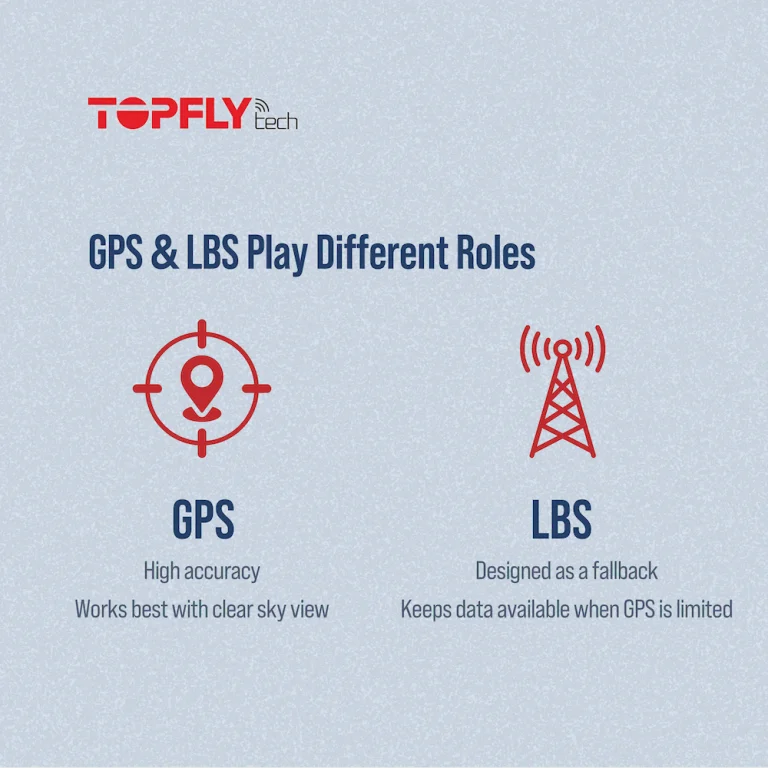
This is a common limitation of location-only monitoring. A GPS tracker can show where a vehicle or asset has traveled, but cargo security may also depend on door activity, lock integrity, environmental conditions, and whether an event occurred at an authorized location.
For logistics operators and telematics service providers, the challenge is no longer simply collecting more tracking data. It is designing a cargo security monitoring system that connects the right hardware, software, and operational responses.
But what does that system actually need? And how can businesses select the right devices without adding unnecessary complexity? Check the WCO report on cargo security
1. Start with the Security Requirement, Not the Tracking Device
Before selecting hardware, identify what needs to be protected and what information must remain available during transportation.
A vehicle tracker, a trailer tracker, and a cargo security device serve different purposes.
For example, a GPS tracker installed in a truck may continue reporting the vehicle’s location after the trailer has been disconnected. If the trailer is the asset that needs monitoring, a vehicle-only tracking setup leaves a visibility gap.
Similarly, knowing that a container remains inside an authorized geofence does not necessarily tell the operator whether its doors have been opened.
A useful starting point is to define three monitoring requirements:
- Asset visibility: Where is the trailer, container, or shipment, and is it moving as expected?
- Cargo integrity: Has a lock been opened, a seal been compromised, or a monitored access point changed status?
- Operational response: Can the monitoring platform identify an exception and direct it to the appropriate person?
These requirements determine whether the project needs a standalone GPS asset tracker, a GPS electronic lock, additional sensors, or a combination of devices.
Not every cargo operation requires all three.
2. Understanding the Hardware: What Each Device Actually Does
A practical cargo monitoring architecture may involve several types of hardware. The key is understanding their individual roles rather than treating them as interchangeable components.
Solar-Powered Asset Trackers: Location and Movement Visibility
Solar-powered asset trackers are designed for assets that may remain outdoors for extended periods without a reliable external power supply.
For example, a SolarX tracker installed on a container can provide location records, movement-related alerts, and other supported monitoring events independently of the truck transporting it.
This is especially useful when containers or trailers frequently change vehicles or remain parked at logistics terminals.
Compatible models can also receive information from BLE sensors, extending the monitoring scope beyond location.
Solar charging can reduce battery-maintenance requirements, although actual performance depends on sunlight exposure, device installation, reporting intervals, and operating conditions.
Best fit: Long-term monitoring of trailers, containers, and other assets where location and movement visibility are the primary requirements.
GPS Electronic Locks: Location Plus Lock Integrity
GPS electronic locks address a different requirement: monitoring and controlling access to secured cargo.
Unlike a standalone asset tracker, a GPS E-lock combines positioning and communication capabilities with physical locking functions.
Depending on the selected model, it may support:
- Locking and unlocking event reports
- Rope-cut or tamper-related alarms
- Position and movement monitoring
- Authorized local or remote unlocking
- Integration with compatible BLE accessories
For example, TOPFLYtech’s SolarGuardX 110 can report locking, unlocking, and rope-cut events, while supporting multiple unlocking methods.
An important consideration is that a GPS E-lock already includes location-tracking capabilities.
If one GPS E-lock provides the required location visibility, security events, and reporting frequency, installing an additional GPS tracker on the same asset may be unnecessary.
A separate tracker becomes more useful when the asset must remain independently visible after the lock is removed, when monitoring responsibilities differ, or when a project specifically requires an additional tracking source.
Best fit: High-value shipments, cross-border transportation, and cargo operations requiring lock-integrity monitoring or controlled access.
BLE Sensors: Additional Cargo Context
Bluetooth Low Energy sensors allow compatible tracking devices to collect information from specific points on an asset.
For instance, a temperature and door-status sensor can help an operator identify whether a refrigerated cargo compartment was opened during transportation and what temperature conditions were recorded.
The sensor communicates locally with a compatible GPS tracker or gateway. That device then forwards the information through its cellular connection to the monitoring platform.
A BLE sensor does not automatically provide independent GPS positioning or a direct cellular connection.
TOPFLYtech’s T-Sense combines temperature monitoring and door-status detection. Other compatible sensors can be selected when humidity or additional measurements are required.
Best fit: Cold-chain logistics, cargo access monitoring, and applications where additional condition data helps explain an operational exception.
3. Which Cargo Security Configuration Fits Your Operation?
The appropriate hardware combination depends on the information required, the asset type, and how the shipment is handled.
The following examples provide starting points for system design.
| Application | Suggested Configuration | Main Monitoring Objective |
|---|---|---|
| Unattended trailers and containers | SolarX 130 | Independent location, movement, and asset-removal events |
| Trailers requiring door monitoring | SolarX 120 or 130 + compatible T-Sense | Asset location, movement, and door-status events |
| Cross-border or high-value cargo | SolarGuardX 110 GPS E-Lock | Location, locking/unlocking events, and rope-cut alerts |
| Temperature-sensitive shipments | Compatible SolarX tracker or GPS E-lock + T-Sense | Shipment location, temperature, and door status |
| Multiple secured doors or compartments | Compatible SolarGuardX main GPS E-lock + SolarGuardX 120 BLE sub-locks | Monitoring multiple locking points through a coordinated system |
These are illustrative configurations, not universal compatibility or deployment guarantees. Device variants, supported accessories, network requirements, and platform functions must be verified for each project.
When Is a Single GPS E-Lock Enough?
Consider a sealed container transported between two distribution facilities.
If the operator needs to monitor location, lock status, and potential rope-cut events, a suitable SolarGuardX main GPS E-lock may already provide the necessary information.
Adding a standalone tracker would increase hardware and integration requirements without necessarily delivering additional operational value.
However, if the container needs continued monitoring after the lock is removed at a checkpoint, an independent asset tracker may serve a separate purpose.
When Should Additional Sensors Be Included?
If the same container carries temperature-sensitive goods, door access and cargo conditions may both matter.
A compatible BLE temperature and door sensor can provide further context, especially when an unexpected opening is followed by a temperature change.
The additional sensor is valuable because it answers a specific operational question, not simply because it adds another data field.
What About Multiple Access Points?
Some logistics projects involve containers, tankers, or equipment with several doors, valves, or compartments.
Rather than installing a separate cellular GPS lock at every access point, a compatible main GPS E-lock and BLE sub-lock architecture can provide coordinated monitoring.
For example, SolarGuardX 120 is designed as a BLE smart sub-lock rather than a standalone cellular GPS tracking device.
The main lock and sub-lock combination must be selected according to confirmed model compatibility, communication range, installation requirements, and software support.
For detailed model differences, explore the TOPFLYtech GPS E-Lock Selection Guide.
4. From a Security Event to an Operational Response
Choosing the right hardware is only the beginning.
A cargo monitoring system becomes valuable when device events can be interpreted and acted upon.
Consider the following illustrative scenario.
Scenario: A High-Value Container Makes an Unscheduled Stop
A logistics company is transporting a high-value shipment between two facilities.
The container uses a GPS E-lock, and the monitoring platform has been configured with the shipment’s planned route, authorized inspection locations, and relevant security rules.
Step 1: Establish the Shipment’s Starting Status
Before departure, the operator associates the lock’s device ID with the correct container and shipment.
The platform records the relevant locking event, location, and time.
This establishes a reference for subsequent monitoring.
Step 2: Detect a Security Exception
During transportation, the vehicle makes an unscheduled stop.
A few minutes later, the GPS E-lock detects and reports a rope-cut event.
When a cellular connection is available, the device sends the event to the monitoring platform.
Step 3: Add Location and Trip Context
The platform associates the security event with available location information and the shipment’s operational status.
The important question is not simply whether a rope-cut alarm occurred.
It is whether the event took place during an approved inspection, authorized unloading operation, or an unexpected stop.
Step 4: Verify Before Escalating
The assigned operator checks the shipment record and contacts the responsible driver or logistics coordinator.
If the event cannot be explained by an authorized operation, it is escalated according to the company’s security procedures.
An alarm indicates a condition requiring investigation. It should not automatically be interpreted as proof of theft.
Step 5: Preserve the Event History
The platform retains the available location, device, and event records according to its configured retention settings.
These records may help the logistics team review the incident, document its response, and resolve subsequent questions about shipment handling.
The difference is operational: instead of reviewing location history after a problem is discovered, the team has a defined process for responding to relevant security exceptions.
5. How the Devices and Monitoring Platform Work Together
For system integrators, understanding the communication architecture is just as important as selecting the hardware.
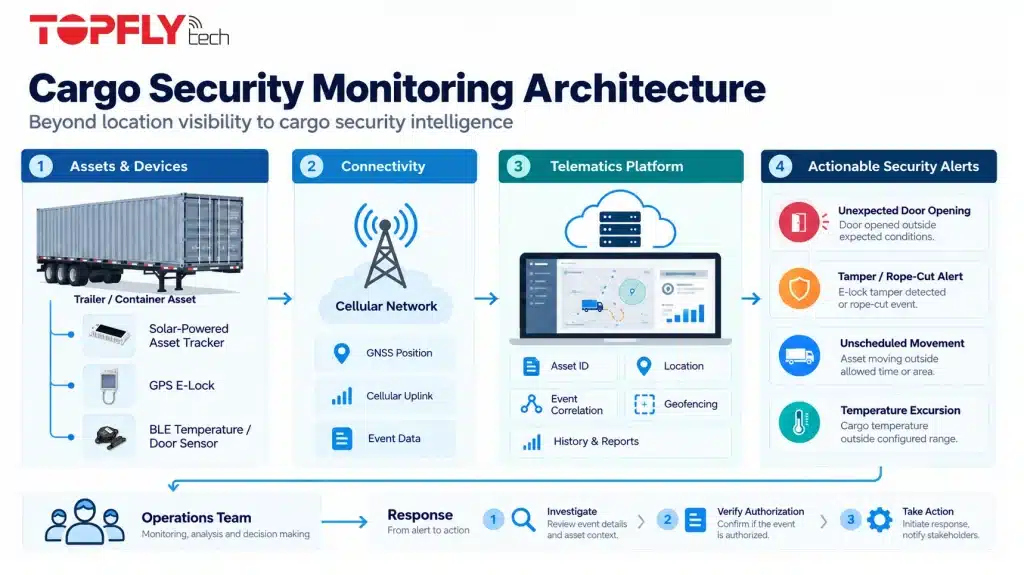
A simplified architecture consists of four stages:
1. Data Collection
GNSS-enabled trackers and main GPS E-locks collect position and device-event information. Compatible BLE sensors or sub-locks communicate locally with their designated main device or gateway.
2. Cellular Communication
The GPS tracker or main E-lock uploads supported data and events through an available cellular network.
3. Telematics Platform
The platform interprets incoming records and associates them with asset IDs, shipment information, locations, and configured monitoring rules.
4. Operational Response
Based on the event type and relevant conditions, the platform can generate notifications, record exceptions, and support investigation workflows.
These stages must work together, but they also have different limitations.
For example, a BLE sensor can remain within communication range of a tracker while the tracker itself has no cellular connection.
The tracker may still collect or store certain information, depending on its configuration. However, remote alerts cannot be delivered until communication becomes available.
Similarly, GPS positioning and cellular connectivity are separate functions. A device may receive GNSS signals without being able to upload its location immediately. More information about Wialon Notification Guide.
What Should System Integrators Confirm?
Before deploying devices with an existing platform, confirm that it can correctly interpret the events required by the project.
These may include location reports, geofence events, lock/unlock status, rope-cut alarms, sensor readings, and any supported remote commands.
For GPS E-lock projects, it is also important to verify authorization controls, command acknowledgments, device identifiers, and event timestamps.
TOPFLYtech works with selected telematics platform partners, including Wialon. Supported features and command availability should be confirmed for the exact hardware model, firmware, and platform configuration.
A device being connected to a platform does not automatically mean every security function is ready for operational use.
That is why event validation and workflow testing should be part of every deployment plan.
6. Before Scaling Up: Five Checks for a Successful Pilot Deployment
Even a technically compatible hardware combination should be tested under realistic operating conditions.
For logistics operators and system integrators, a pilot deployment should answer five essential questions.
1. Is the Installation Suitable for the Asset?
Check whether the tracker, electronic lock, or sensor can be installed securely without interfering with normal cargo handling.
For solar-powered devices, evaluate sunlight exposure. For BLE sensors, verify communication range in the actual installation environment.
Metal containers, cargo placement, and physical obstructions can affect signal performance.
2. Will Connectivity Work Along the Route?
Confirm the cellular technologies, LTE bands, SIM configuration, roaming arrangements, and operator coverage for the intended countries.
Cross-border deployments may involve several networks with different coverage conditions.
Network compatibility should be verified before selecting a device variant.
3. Does the Power Strategy Match the Cargo Security Monitoring Requirements?
A device reporting every few minutes can have a different power-consumption profile from one configured for less frequent updates.
Solar charging can support longer unattended operation, but it does not remove the need to evaluate battery capacity, reporting behavior, and environmental conditions.
The pilot should test the intended configuration rather than relying only on maximum battery-life specifications.
4. Are the Required Events Actually Visible in the Platform?
Test the specific events that matter to the project.
For example:
- An authorized locking or unlocking operation
- An unexpected access or security event
- Movement outside a defined area
- A temperature threshold violation
- Temporary loss and restoration of network connectivity
Confirm that the platform displays the correct device, event type, timestamp, and available location information.
Also verify how events are recovered after communication interruptions.
5. Is There a Clear Response Process?
Finally, determine who receives alerts and what happens next.
A security event may require contacting a driver, confirming an authorized inspection, notifying a logistics coordinator, or escalating to a security team. A pilot should validate these responsibilities as carefully as the hardware.
Otherwise, the operation may collect useful information without having a reliable process for acting on it.
7. Building the Right Cargo Monitoring Solution with TOPFLYtech
A reliable cargo security system does not begin with the most feature-rich device. It begins with a clear understanding of the asset, monitoring requirements, deployment environment, and existing software infrastructure.
TOPFLYtech offers hardware options for different parts of this process.
The SolarX 130 solar-powered asset tracker supports independent asset tracking, movement monitoring, and compatible BLE sensor connectivity.
For shipments requiring physical locking and security-event reporting, the SolarGuardX 110 GPS E-Lock combines GNSS positioning, cellular communication, and locking-related monitoring functions.
The T-Sense temperature and door sensor can add cargo-condition and access-related information through compatible devices.
Where multiple locking points are required, the SolarGuardX 120 BLE smart sub-lock provides another architectural option when paired with a supported main lock.
These technologies can be selected individually or combined where the project requires them.
The objective is not to install more hardware. It is to ensure that each device contributes information or control that the operation actually needs.
Frequently Asked Questions
Do I Need Both a GPS Tracker and a GPS E-Lock?
Not necessarily. A GPS E-lock already includes tracking functions. An additional asset tracker should be considered when independent asset visibility, separate reporting requirements, or operational continuity after lock removal makes it useful.
Is Lock Status the Same as Door Status?
No. A locking or unlocking event describes the electronic lock’s state or operation. It does not necessarily confirm every physical door-opening event. A compatible door sensor may be needed when actual door-status monitoring is required.
Can BLE Sensors Send Alerts Directly to a Tracking Platform?
Typically, BLE sensors communicate with a compatible GPS tracker or gateway, which forwards the information through its cellular connection. Sensor compatibility, range, and data reporting must be checked for the selected hardware.
Can Cargo Security Monitoring Work Without Cellular Coverage?
Some devices can record supported events while offline and upload buffered data after reconnection. However, remote notifications cannot be delivered in real time without an available communication path.
Conclusion: Better Cargo Security Starts with Better System Design
Moving beyond GPS tracking does not mean replacing location monitoring. It means making location information more useful by connecting it with the security and operational events that matter.
For some projects, independent solar-powered asset tracking is sufficient. Others require physical locking, cargo-access detection, environmental monitoring, or coordinated control across multiple access points.
The right solution depends on the actual risk, transport workflow, and deployment environment.
The goal is not to monitor everything. It is to monitor what matters—and know what to do when something changes.
Planning a Cargo Security or Asset Tracking Project?
Whether you are securing cross-border shipments, monitoring unattended trailers, or integrating tracking hardware into an existing telematics platform, selecting the right configuration early can help avoid unnecessary deployment and integration complexity.
To discuss your requirements with TOPFLYtech, share the following project details:
- The assets or cargo you need to monitor
- The countries and transport routes involved
- The security events or conditions that matter
- Your existing telematics platform, if applicable
- The approximate number of devices planned for the initial deployment
Contact TOPFLYtech to Discuss Your Cargo Monitoring Requirements →