Choosing between vehicle, trailer or cargo tracking starts with one question: what must remain visible when the operating context changes? A vehicle tracker follows the powered unit and can report driving or vehicle data. A trailer tracker stays with the trailer after it is uncoupled. A cargo tracker follows the shipment itself and may add temperature, humidity, door or handling events. If access must also be controlled, a GPS e-lock adds a separate security layer.
For many fleets, the right vehicle trailer cargo tracking design is therefore not one device. It is a small architecture in which every tracker has a defined object, power source, reporting policy and role in the software platform. This guide shows how to make that choice without overbuying hardware or leaving a visibility gap at the handover points.
Why one GPS device cannot solve every visibility problem
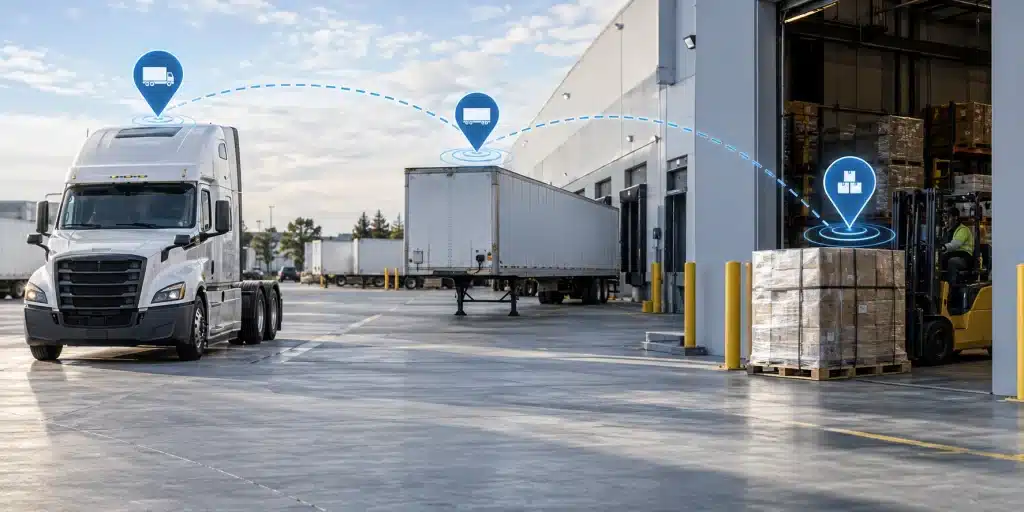
A tracker can only report what it stays attached to, what it can sense and what its power budget allows. That sounds obvious, but it is the source of many weak deployments. A device installed in the tractor may show that the tractor reached the depot; it cannot prove that the assigned trailer is still attached. A tracker mounted on a refrigerated trailer may report the trailer’s position; it does not automatically describe the condition of each shipment inside. A cargo tracker may travel with a pallet, but it will not normally provide ignition, driver-behavior or vehicle-bus data.
| Tracking layer | The record follows | Typical questions | Power reality | Usual device approach |
|---|---|---|---|---|
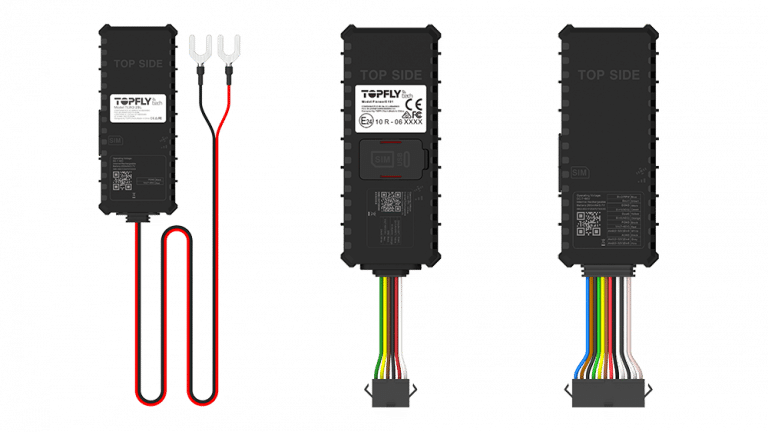
| Vehicle | Tractor, van, car or powered equipment | Where is the vehicle? How is it being driven? What does the vehicle report? | Vehicle power is normally available | Hardwired or OBDII tracker |
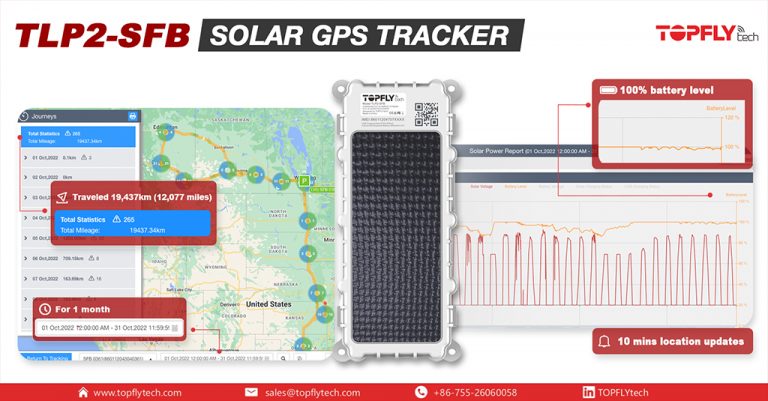
| Trailer or asset | Trailer, container or mobile equipment | Where is the asset when detached? Is it moving, idle or leaving a geofence? | Power may be intermittent or absent | Battery-powered, dual-power or solar asset tracker |
| Cargo | Shipment, pallet, parcel or load | Where is this consignment? Was its condition or door state acceptable? | Usually self-powered or sensor-to-gateway | Cargo tracker, BLE sensor, logger or gateway architecture |
| Access | Door, seal, valve or compartment | Was access authorized? Was the lock or seal disturbed? Where did it happen? | Independent power and a defined charging plan | GPS e-lock, sometimes with sub-locks or sensors |
The first architecture decision is therefore about identity. Decide whether your operational record is keyed to a vehicle_id, trailer_id, shipment_id, sensor_id or lock_id. These identifiers can be linked for a trip, but they should not be treated as interchangeable. When a tractor changes trailers or a load changes vehicles, that distinction preserves the audit trail.
If that event history must be shared across customers, carriers or software platforms, use a defined data model rather than a collection of custom status labels. The official GS1 EPCIS and Core Business Vocabulary standard is a useful reference for structuring the what, when, where, why and how of supply-chain events. A telematics platform does not have to implement EPCIS to benefit from the same discipline: identifiers, timestamps, locations, business steps and sensor observations should have consistent meanings.
Vehicle tracking: use reliable power to collect operational data
Vehicle tracking is the right foundation when the business decision belongs to the powered unit: dispatching a service van, reviewing a route, detecting towing, monitoring driver behavior or reading supported vehicle data. Because vehicle power is available, the tracker can usually report more frequently than a standalone asset device without making battery replacement the central maintenance problem.
Choose hardwired tracking for a fixed, controlled installation
A hardwired tracker is usually the better fit when the device will stay with the vehicle for a long deployment and the operator wants a concealed installation, ignition input or additional I/O. Depending on the selected model and configuration, those inputs may support accessories, sensors, relays or vehicle-specific workflows.
Hardwiring also makes installation quality part of system quality. Define where power, ground and ignition will be taken; how the antenna will be oriented; which circuits are approved; and how technicians will verify the installation. A tracker with good specifications can still produce a poor result if it is placed under heavy shielding, wired inconsistently or installed where it is easily damaged.
Choose OBDII when deployment speed and portability matter
An OBDII tracker suits mixed fleets, rental fleets, dealer programs, insurance telematics and other cases where fast, repeatable installation matters. It can also provide supported vehicle data without a custom wiring job. The trade-off is physical accessibility: the port may be visible to the driver, needed during workshop diagnostics or positioned awkwardly in some vehicles.
Before scaling an OBDII rollout, test the exact vehicle makes and models in scope. Confirm port clearance, sleep behavior, battery impact, supported data fields and what happens when the device is removed. “Plug and play” reduces installation work; it does not remove the need for a compatibility check.
Do not request every available data point
Start with the operational decision, then work backward to the data. A dispatcher may need current location, ignition and trip state. A maintenance team may need selected diagnostic events. A safety workflow may need harsh-driving events and a method for coaching or escalation. Collecting fields without an owner or response process creates dashboard noise and unnecessary integration work.
Trailer tracking: design for uncoupled time, not towing time
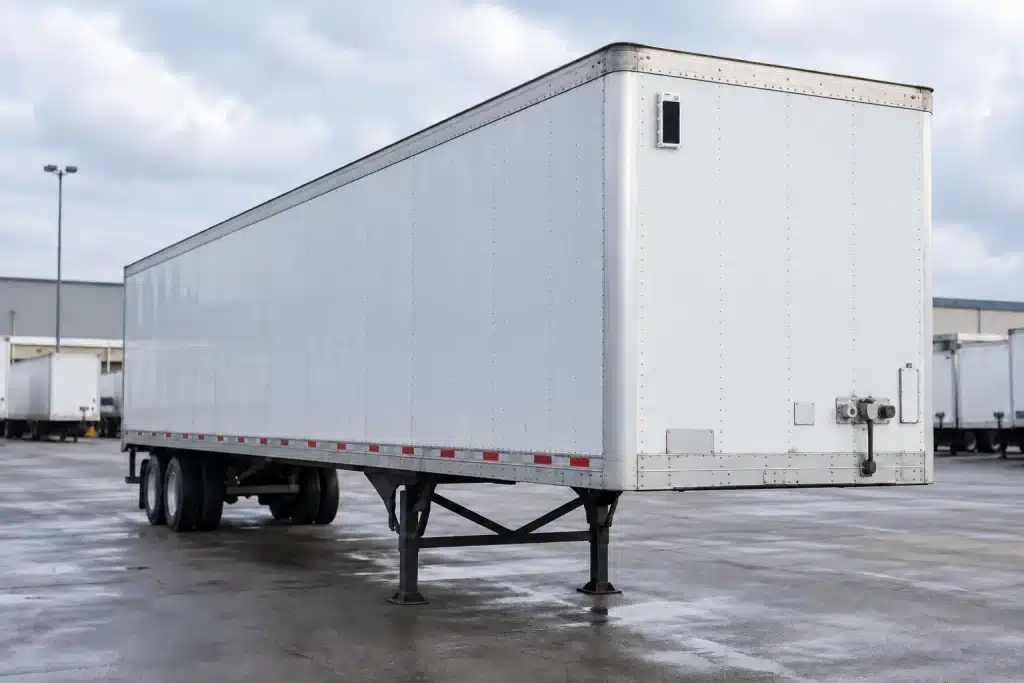
A trailer is easiest to track while connected to a tractor. The harder—and more valuable—part is the period after it has been dropped in a yard, left at a customer site or transferred to another tractor. The trailer architecture should be designed around that uncoupled period.
Map every power state in the operating cycle
Write down what happens while the trailer is being towed, waiting at a depot, standing at a customer location and undergoing maintenance. If auxiliary power is only available during part of that cycle, treat it as intermittent—not continuous. A dual-power tracker can use external power when present and preserve its internal battery when the trailer is detached.
A battery-powered tracker is practical when sunlight is unreliable, the device must be concealed or the reporting profile is relatively light. A solar-powered tracker is attractive for outdoor assets with suitable exposure, but “solar” is not the same as “maintenance free.” Panel orientation, shade, dirt, temperature, cellular conditions and reporting frequency all affect the energy balance.
Make reporting policy state-aware
The device does not need the same behavior in every state. A moving trailer may justify more frequent updates and route alerts. A trailer that has remained inside an approved yard can use a lower-power schedule. Unexpected movement, geofence exit, removal or tamper events may wake the device and raise an exception.
This is where total cost is won or lost. The cheapest hardware is not economical if it creates repeated charging visits. Equally, an aggressive reporting interval is not useful if nobody acts on the extra points. Build the policy around decisions such as yard inventory, dwell review, unauthorized movement and recovery—not around the maximum rate printed in a specification sheet.
Cargo tracking: separate location, condition and access
“Track the cargo” can mean three different jobs:
- Location: determine where a shipment, pallet or parcel is during handovers.
- Condition: monitor temperature, humidity, shock or another cargo-relevant state.
- Access: record door, seal, lock or compartment events.
Those jobs may share a platform, but they do not always require the same hardware. A shipment-level tracker is useful when the load can leave the original vehicle or trailer. A fixed tracker plus wireless sensors may be better when the same refrigerated trailer carries many loads and the operator wants reusable equipment. A standalone logger can suit post-trip evidence, while a gateway architecture is required when the team needs events during the trip. The right choice depends on when someone must act on the data.
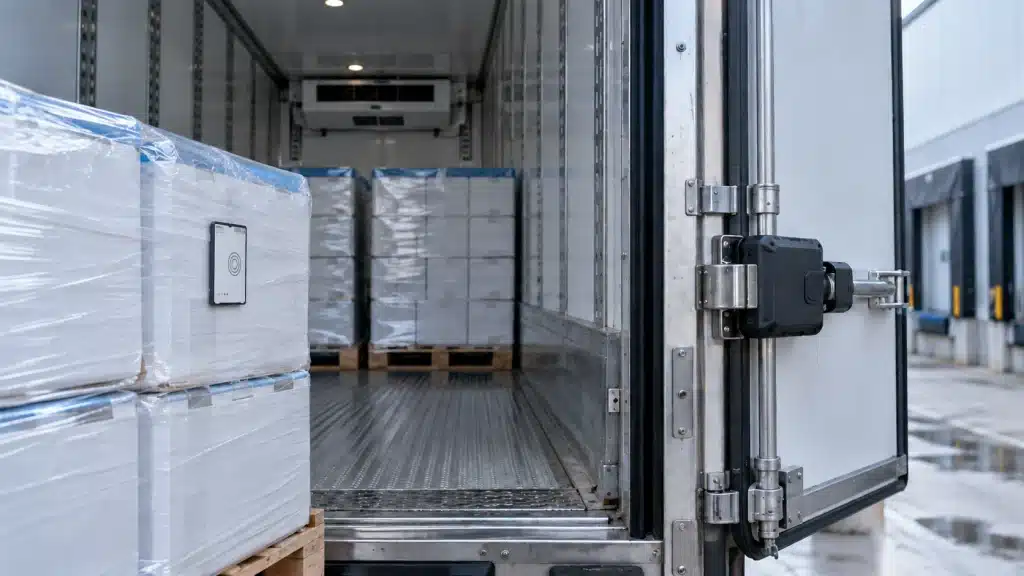
Design the sensor-to-platform path before choosing the sensor
A wireless cargo sensor does not automatically send data to a server. It needs a compatible nearby gateway—often a vehicle or asset tracker with BLE support—or a separate reading workflow. Confirm the radio relationship, pairing method, sensor range in the real installation, data buffering, sampling interval, gateway reporting interval and behavior when connectivity is lost.
For temperature-sensitive cargo, also decide where the sensor will be mounted. Air near a door, a return-air channel and the center of a loaded pallet can behave differently. The goal is not simply to collect a temperature value; it is to place the sensor where the reading supports the operational or quality decision. Validate placement with the people responsible for the cargo and the equipment.
Compliance requirements depend on the cargo and the market. For example, the U.S. FDA rule on sanitary transportation of human and animal food addresses responsibilities for vehicles, transportation operations, records and temperature control where applicable. It does not turn a generic sensor into a compliant system. The shipper, carrier and quality team still need to define the required conditions, responsibilities, records and response process for the specific shipment.
Keep the shipment record independent of the carrier asset
When cargo changes custody, the platform should preserve the relationship between shipment, asset and device over time. A practical trip record can include the shipment ID, assigned trailer or container, tractor, tracker, sensors, lock, driver or carrier, planned route, geofences and alert recipients. At each handover, update the relationship instead of overwriting the history.
Use a GPS e-lock when access control is part of the requirement
A GPS e-lock is justified when the operation must do more than detect a door opening. It can combine a physical locking or sealing workflow with location, lock state and tamper-related events. Typical use cases include controlled cargo release, cross-border or bonded movements, high-value shipments, multi-compartment vehicles and routes where the place and time of access matter.
Do not treat the lock as a standalone gadget. Define the full operating procedure:
- Who is allowed to lock and unlock?
- Which methods are permitted at origin, checkpoints and destination?
- What should happen if cellular coverage is unavailable?
- Which event is treated as tampering, and who receives it?
- How are emergency access, failed unlocks and device charging handled?
- Which platform stores the event history and who can audit it?
An electronic lock also does not replace load restraint or other physical safety controls. U.S. road operators can use the FMCSA cargo securement rules as an official reference for the separate obligation to keep cargo immobilized or secured during transport. Operators in other markets should check the corresponding authority and route-specific requirements.
If the only requirement is to know whether a door opened, a door sensor may be simpler. If the requirement is to prevent or authorize access and keep a location-linked record, the GPS e-lock layer is more appropriate. Model capabilities, certifications, connectivity, supported unlock methods and accessory compatibility should be confirmed for the target market and workflow.
Three practical combination architectures
1. Tractor fleet with interchangeable trailers
Use: a hardwired or OBDII tracker on each tractor, plus an independent battery or solar tracker on each trailer.
Why: dispatch can see the powered vehicle, while yard operations retain trailer visibility after uncoupling. In the platform, a trip temporarily associates the tractor ID and trailer ID. A mismatch alert can flag when the assigned pair is not moving together or when a trailer leaves without an expected tractor relationship.
Watch: do not infer trailer identity solely from proximity. Define how tractor–trailer pairing is created, verified and closed.
2. Refrigerated trailer carrying condition-sensitive loads
Use: a trailer tracker with independent power, paired wireless temperature and door sensors, and shipment IDs in the platform. Add a vehicle tracker only if driver or tractor data is also required.
Why: the trailer remains visible during dwell time, while sensor data describes the cargo environment. Alerts should combine context—for example, an out-of-range condition while the door is open may require a different response from the same reading during a closed, stationary period.
Watch: validate sensor placement, gateway coverage and offline buffering in a fully loaded trailer, not only in an empty test vehicle.
3. High-risk or controlled-access cargo
Use: a GPS e-lock associated with the container, trailer door, compartment or valve; add cargo-condition sensors where required. The tractor may still have its own vehicle tracker.
Why: the platform can keep vehicle movement, cargo access and cargo condition as distinct event streams under one trip. This makes exceptions easier to investigate: the team can ask where the vehicle was, which access event occurred and what the cargo condition showed at that time.
Watch: test authorized, unauthorized, offline and emergency workflows. Security hardware without a response procedure only moves the blind spot from the road to the control room.
How to choose by lifecycle, power, network, installation and risk
| Decision area | Questions to answer | Architecture implication |
|---|---|---|
| Operating lifecycle | What is tracked? Can it change tractor, trailer, carrier or owner? How long must the device stay with it? | Choose the device identity and whether associations must change during a trip. |
| Power | Is power continuous, intermittent or absent? Is sunlight dependable at the actual mounting point? Who maintains batteries? | Choose hardwired, OBDII, dual-power, battery or solar; then set a realistic reporting policy. |
| Network | Which countries and operators are used? Which LTE technology and bands are available? What must work while offline? | Select the regional hardware variant, SIM or roaming plan, buffering behavior and fallback procedure. |
| Installation | Must the device be hidden, removable, exposed to sunlight or accessible for service? What materials may block signals? | Define mounting, antenna orientation, tamper protection, technician steps and acceptance checks. |
| Data | Which decision will each field support? Is live data required, or is a post-trip record enough? | Choose sensors, sampling, reporting, alerts, retention and dashboard ownership. |
| Risk | Is the concern delay, theft, unauthorized access, condition excursion, misuse or loss of custody? | Match the control to the risk: visibility, condition sensing, tamper detection or access control. |
| Integration | Which platform receives the data? Are protocols, commands, timestamps, IDs and units normalized? | Confirm compatibility before purchase and test the complete device-to-alert workflow. |
For projects considering LTE-M or NB-IoT, the GSMA Mobile IoT Deployment Guide provides an industry reference for features, interoperability and roaming considerations. Use it to improve the questions in a network review, then confirm current bands, operators, roaming and service behavior for every deployment country with the chosen connectivity providers.
Run a workflow pilot, not a coverage demonstration
A map point on a dashboard proves very little. A useful pilot follows a representative operating cycle and checks the moments where visibility usually breaks: installation, departure, uncoupling, yard dwell, handover, door opening, loss of coverage, reconnection, authorized access, alert escalation and device maintenance.
Set acceptance criteria before the pilot. These can cover event delivery, timestamp consistency, device–asset association, battery or charging behavior, sensor readings, alert ownership, offline recovery and the time required to install or service a unit. Record exceptions and decide whether the fix belongs in hardware selection, firmware configuration, platform logic or the operating process.
Recommended TOPFLYtech categories and next step
Use product categories as starting points, then confirm the exact model, connectivity variant, protocol and accessories for the deployment country:
- Powered vehicles: compare TOPFLYtech hardwired trackers with TOPFLYtech OBDII trackers.
- Detached trailers and non-powered assets: review battery-powered asset trackers and solar-powered asset trackers.
- Cargo condition: examine the cold-chain monitoring architecture for tracker, sensor and door-status options.
- Cargo access and tamper workflows: compare the available GPS e-lock models and roles.
- Software integration: check compatible platform partners and confirm the required protocol and command workflow.
Before requesting a quotation, prepare a one-page architecture brief containing the tracked object, operating cycle, countries and networks, power states, reporting and alert requirements, installation limits, sensors, access-control process, platform and pilot acceptance criteria. That brief will make product selection faster and expose gaps before devices reach the field.
Frequently asked questions
Can a vehicle GPS tracker also track the trailer?
It can show the tractor’s location while the trailer is attached, but it does not provide independent trailer visibility after uncoupling. If trailer inventory, dwell time or unauthorized movement matters, give the trailer its own device identity.
Should a trailer use a battery or solar GPS tracker?
Choose based on the real energy budget. Battery power can support concealed or low-reporting deployments without dependable sunlight. Solar can reduce charging work when the mounting point receives suitable exposure. In both cases, verify reporting frequency, stationary time, temperature, cellular conditions and the maintenance process.
Is cargo temperature monitoring the same as cargo tracking?
No. Location identifies where the shipment or carrier asset is; a temperature sensor describes one part of cargo condition. The two can be combined through a tracker or gateway, but the architecture must define sensor placement, sampling, transmission, buffering and alert ownership.
When is a GPS e-lock better than a door sensor?
A door sensor is suitable when the requirement is to detect open and closed states. A GPS e-lock is more appropriate when the operation must authorize or prevent access, associate lock events with location and retain a security audit trail.
Can all devices report to the same telematics platform?
They can when the platform supports the required device protocols, data fields and command workflows. Confirm integration at model level, normalize device and asset identifiers, and test location, sensor, lock, alert and offline-recovery events before rollout.