An asset tracking strategy? An asset tracker should not begin with a product specification sheet. It should begin with a simpler operational question:
How long does this asset need to remain visible?
A tracker used for a temporary shipment has different requirements from one installed on a container, trailer or piece of heavy equipment for several years. Deployment duration affects installation, reporting frequency, power strategy, maintenance workload and total operating cost.
The right asset tracking strategy therefore starts with the deployment—not the device.
The Short Answer
For temporary or frequently changing deployments, prioritize flexible installation, simple management and sufficient battery capacity for the expected operating period.
For extended outdoor deployments, prioritize sustainable energy availability, durable installation and reduced maintenance. A solar-assisted tracker may be suitable when the asset receives adequate sunlight, while a long-life battery-powered tracker may be more appropriate when solar exposure is unreliable.
In either case, the correct choice depends on four connected factors:
- Deployment duration
- Required location and event visibility
- Reporting frequency
- Available power and maintenance access
1. Define the Deployment Duration
Deployment duration establishes the basic operating envelope for an asset tracker.
Temporary deployments
Temporary tracking may include:
- Individual shipments
- Rental equipment
- Short-term projects
- Portable machinery
- Dealer or channel deployments
- Assets that frequently change ownership or assignment
These applications usually benefit from quick installation, portability and easy reassignment.
TOPFLYtech identifies parcel tracking, temporary projects, smaller mobile assets and short-term or higher-frequency applications as typical uses for its battery-powered asset tracker category.
A compact battery-powered tracker can support these workflows without requiring a connection to the asset’s electrical system. However, its battery capacity and reporting configuration still need to match the intended deployment period.
Extended deployments
Long-term monitoring may involve:
- Trailers and containers
- Construction equipment
- Agricultural machinery
- Remote industrial assets
- Equipment with limited maintenance access
- Assets that remain idle for long periods
For these deployments, the operational challenge is not simply installing a tracker. It is maintaining useful visibility without creating a recurring battery-replacement or recharging workload.
Solar-assisted tracking can reduce dependence on manual charging when the asset operates outdoors and the installation position receives sufficient sunlight. However, solar power should not be treated as automatic or unlimited: orientation, location and shading all affect available solar energy, according to the U.S. Department of Energy’s solar modeling guidance.
2. Decide What “Visible” Actually Means
Asset visibility does not always require a continuous stream of location points.
For one operation, visibility may mean receiving a daily confirmation that a container remains in the correct yard. For another, it may mean its asset tracking strategy detecting movement immediately after a parked machine leaves an authorized area.
Before selecting a tracker, define the events the operation needs to observe.
Periodic location updates
Scheduled location reports can answer questions such as:
- Where is the asset now?
- Has it reached its destination?
- How long has it remained at the same location?
- When was its last confirmed position?
Shorter reporting intervals provide more detailed location history but normally require more device activity and data transmission. Longer intervals can conserve energy but provide less granular visibility.
Movement detection
Movement-based reporting is useful when teams need to know when an asset:
- Starts moving
- Stops moving
- Leaves storage
- Moves outside an expected schedule
- Returns to an active operating state
This approach can focus reporting on operationally meaningful changes rather than treating every minute as equally important.
Event-based alerts
Depending on the tracker and installation, relevant events may include:
- Unauthorized movement
- Geofence entry or exit
- Device removal
- Low battery
- Door activity
- Temperature or humidity exceptions
For example, TOPFLYtech states that the SolarX 120 supports movement, removal and low-power alerts and can work with compatible Bluetooth sensors. These functions may be valuable when visibility must extend beyond location alone.
The required event types should be confirmed before choosing a model; they should not be assumed simply because a device is described as an “asset tracker.”
3. Match Reporting Frequency to the Business Decision
“Real-time tracking” sounds reassuring, but it is not a complete requirement.
A more useful question is:
How quickly must the team receive an update to make the right decision?
| Operational requirement | Possible reporting approach | Main consideration |
|---|---|---|
| Confirm that an idle asset remains in place | Scheduled reports | Energy efficiency |
| Monitor an active shipment | More frequent location reports | Route visibility |
| Detect unauthorized movement | Movement-triggered alert | Response time |
| Document arrival or departure | Geofence event | Boundary accuracy |
| Monitor remote equipment over a long period | Scheduled plus event-based reporting | Maintenance workload |
Frequent communication, GNSS acquisition, sensor activity and network conditions all influence energy consumption. That is why battery estimates should be based on defined operating assumptions rather than a battery-capacity number alone.
The GSMA’s battery-performance methodology likewise evaluates power consumption under specified technologies and parameter sets, reinforcing the need to compare devices under clearly defined conditions rather than relying on an isolated headline figure. See the GSMA Battery Life Measurement and Current Consumption Technique.
4. Choose the Appropriate Power Strategy
Once deployment duration and reporting behavior are defined, the power decision becomes more practical.
When battery-powered tracking makes sense
Battery-powered trackers may be suitable when:
- The installation must be fast and flexible
- The asset has no reliable external power
- The tracker will be reassigned between assets
- Solar exposure is limited or unpredictable
- The expected deployment fits a validated battery plan
- The device can be accessed for replacement or recharging
Battery life should be estimated using the actual reporting interval, movement pattern, sensor requirements and operating conditions.
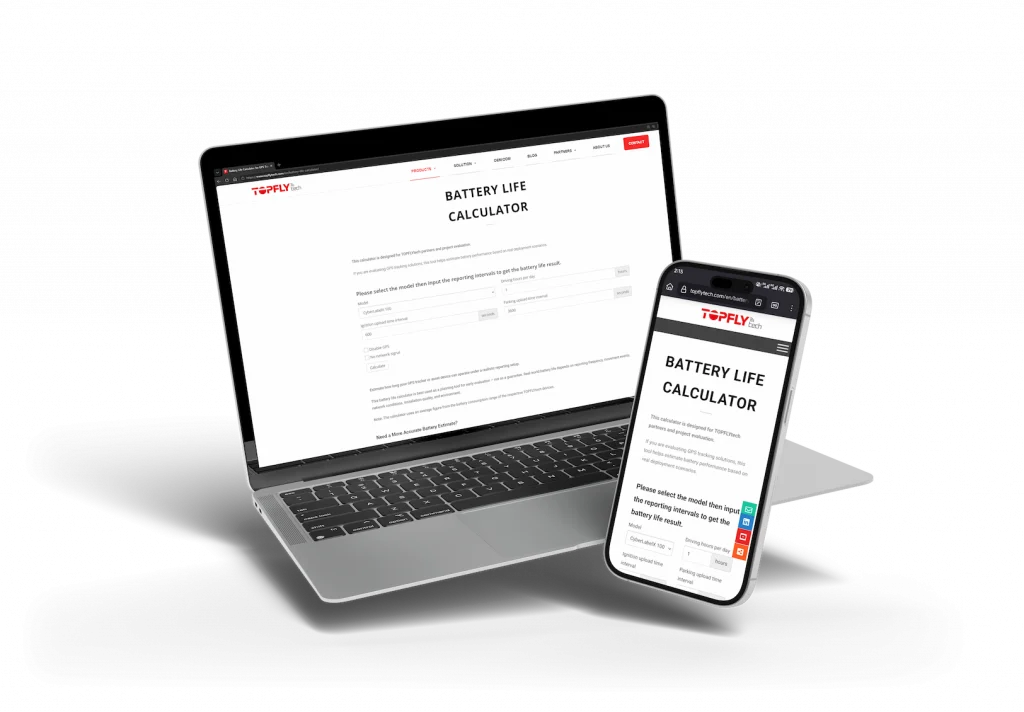
TOPFLYtech’s Battery Life Calculator is designed to help teams compare runtime assumptions for compatible GPS trackers and IoT devices. The result should be treated as a planning estimate and checked against the intended field conditions.
When solar-assisted tracking makes sense
Solar-assisted trackers may be suitable when:
- Assets spend substantial time outdoors
- Deployment is expected to continue for an extended period
- Manual charging or battery replacement is difficult
- The mounting position can receive useful sunlight
- Higher energy availability is required
- Maintenance visits are expensive or disruptive
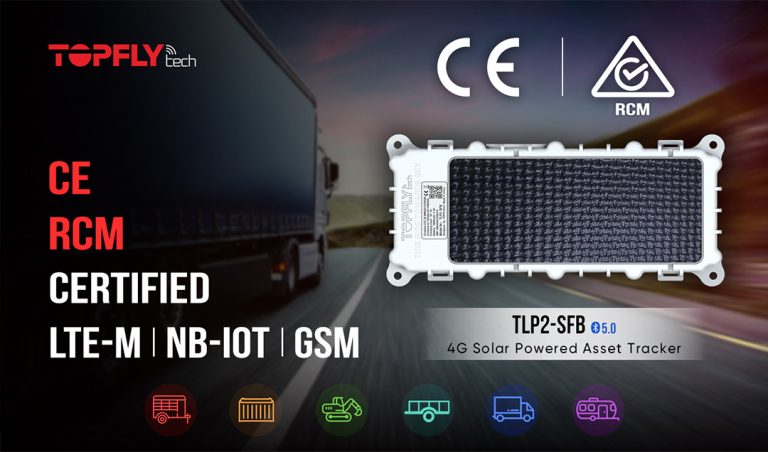
TOPFLYtech’s solar-powered range includes devices intended for trailers, containers and other outdoor assets. Its solar-powered asset tracking guide provides a more detailed evaluation framework for these deployments.
Solar assistance does not remove the need for deployment planning. Teams should still assess shading, asset orientation, seasonal conditions, reporting settings and periods when equipment may be stored indoors.
5. Evaluate Maintenance Before Comparing Purchase Price
The least expensive tracker is not always the lowest-cost tracking asset tracking strategy.
Long-term operating cost may also include:
- Installation labor
- Charging or battery replacement
- Travel to remote assets
- Device removal and reassignment
- Connectivity management
- Lost visibility caused by depleted batteries
- Sensor and accessory maintenance
- Platform integration and alert management
A tracker that requires frequent service may be acceptable for accessible assets but inefficient for containers or equipment distributed across remote locations.
For extended deployments, maintenance effort should be treated as a selection criterion—not an afterthought.
A Practical Asset Tracker Selection Checklist
Before selecting a tracker, document the following:
- What asset will be monitored?
- How long will the deployment last?
- Will the tracker stay on one asset or move between assets?
- How often is a location update required?
- Which events require immediate alerts?
- Will the asset normally be indoors, outdoors or both?
- Is there reliable access to sunlight or external power?
- How often can the tracker be serviced?
- Which cellular technologies and frequency bands are required?
- Are environmental protection or regional certifications required?
- Will external temperature, door or other sensors be needed?
- What platform or API must receive the data?
If these questions cannot be answered, comparing product specifications is premature.
Build the Asset Tracking Strategy Before Selecting the Device
The best asset tracker is not necessarily the tracker with the largest battery, the biggest solar panel or the longest feature list.
It is the tracker whose reporting behavior, energy source, installation method and maintenance requirements match the real deployment.
Start with how long the asset must remain visible. Then define what visibility means, how quickly the information must arrive and how the tracker will remain powered.
Once those decisions are clear, selecting the right configuration becomes considerably easier.
Need help matching a tracker to your deployment?
Explore TOPFLYtech asset tracking solutions or contact the TOPFLYtech team with your asset type, deployment duration, reporting requirements and operating region.
FAQ
How do I choose the right asset tracker?
Start by defining the deployment duration, required reporting interval, event alerts, installation environment, available power and maintenance access. Then compare trackers against those requirements.
Is a solar tracker always better for long-term tracking?
No. Solar-assisted tracking is most useful when the installation receives sufficient sunlight. A long-life battery-powered tracker may be more appropriate for shaded, indoor or unpredictable environments.
What affects an asset tracker’s battery life?
Battery life can be affected by reporting frequency, movement activity, GNSS use, cellular communication, sensor operation, signal conditions and temperature. Runtime estimates should always state their operating assumptions.
Do asset trackers need continuous location reporting?
Not always. Scheduled updates, movement-triggered reports and event alerts may provide sufficient visibility while reducing unnecessary communication and energy use.
What does real-time asset tracking mean?
“Real time” has no single useful interval for every operation. Buyers should define the maximum acceptable delay between an event and the corresponding notification.