Air Temperature vs Product Temperature in Cold Chain Monitoring
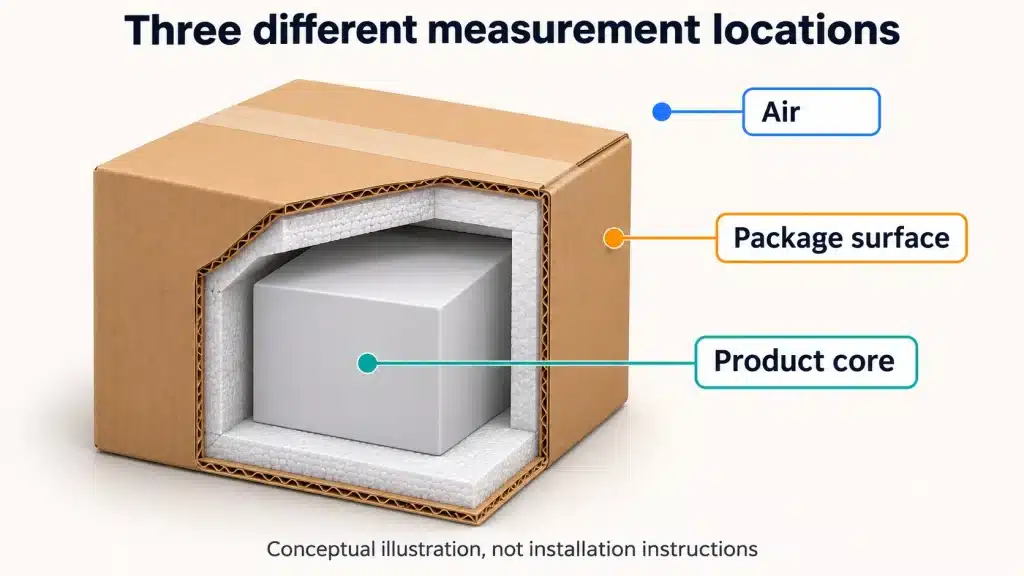
Air temperature vs product temperature is a difference in measurement target. A sensor in refrigerated air records conditions at that location. The reading does not automatically show the temperature inside a carton or at the center of the goods. Cold-chain temperature monitoring should define what must be measured before selecting a sensor, probe or alarm rule.
Start by separating three measurement targets: air, package surface and product core. An external probe can make the measurement position more flexible, but the probe does not automatically turn an air reading into a product-core reading.
Product references checked: . Confirm the selected probe, device configuration and current documentation before deployment.
What does each temperature reading actually tell you?
A temperature sensor reports conditions at its sensing element. The meaning of that reading depends on the measurement point and the installation method. A highly accurate sensor can still answer the wrong operational question if the measurement point is unsuitable.
On small screens, scroll horizontally to view all table columns.
| Measurement target | What the reading describes | What it does not establish by itself |
|---|---|---|
| Air temperature | The air surrounding the sensing element, such as a selected location in a refrigerated compartment. | The temperature inside every package or at the center of the goods. |
| Package-surface temperature | The temperature at a particular package surface, using a suitable contact method. | The temperature throughout the package or inside the product. |
| Product-core temperature | The temperature at an internal product location, measured with an appropriate method. | The condition of the whole shipment from one sample, or suitability for product release without the required assessment. |

Why can air and product temperatures differ?
Air and cargo do not necessarily respond to a temperature change at the same rate. Packaging, product mass and airflow affect how heat reaches or leaves the goods. For example, opening a refrigerated trailer door may change a nearby air reading before a packaged load reaches the same temperature.
Vaisala’s temperature-mapping guidance explains that a change in air temperature takes time to affect product temperature, particularly for packaged, liquid or higher-volume products. That supports an important distinction: an air-temperature event is evidence about air conditions, not a direct measurement of every item in the load.
This does not make an air-temperature alarm unimportant. It means the response must use the measurement context and the shipment’s documented requirements. Do not assume that a short excursion is harmless, or that goods are acceptable because one air sensor stayed within a limit.
How should you choose a temperature sensor location?
Choose the location by the question the monitoring system must answer. A point near a refrigeration outlet can describe that local airstream. A point touching a metal wall can be influenced by contact with the wall. A convenient mounting point is not automatically representative of the cargo.
Before selecting permanent locations, document:
- The measurement objective: compartment air, a particular package location or another defined target.
- The load arrangement: packaging, pallet positions and the space available for air circulation.
- The operating conditions: loading, unloading, door openings, stops and refrigeration cycles.
- The installation: mounting position, probe attachment, cable routing and protection from damage.
Where a qualified temperature-mapping or validation study is required, use that work to justify routine monitoring locations. This article does not prescribe a universal mounting point, sensor count or acceptance threshold. A tracking sensor is also not automatically a calibrated reference instrument.
When does an external temperature probe help?
An external probe allows the sensing point to be placed separately from the sensor housing. That can help when the required measurement point is difficult to reach with a complete sensor body. The probe, cable, connector and housing still need to suit the actual installation.
The TOPFLYtech T-one probe sensor sends measurements by BLE to a compatible tracker or BLE hub. The current product page lists a measuring range of −40°C to +125°C for the base T-one probe, while the housing operating range is −30°C to +80°C. These are different limits: the probe range must not be used as the operating rating for the entire device.
Check the selected probe version and its documents rather than applying one specification to every configuration. An external probe alone does not establish suitability for direct food contact, penetration measurements, sterilization or a regulated product-acceptance procedure.
What can door-status data add?
Door-status data can help explain the circumstances around a temperature event. If a temperature change occurs alongside a recorded door opening, the operations team has additional context to investigate. The door event does not measure product temperature or prove that the goods were damaged.
The TOPFLYtech T-Sense temperature and door sensor combines environmental temperature measurement with door-status detection. For a deployment, confirm that door sensing is enabled and that the selected tracker, firmware and platform receive and interpret the required data correctly.
A temperature reading and a door event remain different observations. Keep the measurement location, event time and shipment context available when reviewing them together.
What should you verify before a fleet rollout?
Use a representative pilot to check the complete measurement path, not just whether a value appears on a dashboard.
- Define what the reading represents. Name the measurement target and record the sensor or probe location.
- Check the hardware limits. Review the probe and housing ratings separately, together with the installation conditions and required measurement method.
- Compare readings appropriately. Use a suitable reference and a documented comparison method. A difference between two locations is not automatically a calibration error.
- Separate the reporting stages. Confirm measurement, BLE broadcast, tracker collection and platform upload settings. These intervals need not be identical.
- Test the deployed configuration. Check reception and reporting with the actual load, mounting position and door conditions. Open-field radio specifications do not prove performance in the installed environment.
- Agree on the response. Define who reviews an exception and what evidence is required. Base limits and decisions on the shipment’s approved requirements, not on a generic blog example.
Retain the probe version, tracker and firmware details, configuration, installation photos and comparison records. These details make a reading easier to interpret when the same deployment is repeated across more vehicles.
How does this fit into a cold-chain monitoring solution?
Sensor placement defines the meaning of the measurement. The tracker and platform determine how the supported data reaches the people responsible for the shipment. Both need to match the operating workflow.
For hardware selection, start with the TOPFLYtech temperature and humidity monitoring solution. If the open question is the monitoring architecture rather than the measurement point, see the existing guide to BLE sensors, standalone loggers and real-time visibility.
Planning a refrigerated transport project? Share the measurement target, shipment conditions, required data and existing platform with TOPFLYtech. Request a sensor and tracker compatibility review before choosing the final configuration.
Frequently asked questions
Does an external probe automatically measure product-core temperature?
No. An external probe measures at its sensing element. Product-core measurement requires a suitable probe, an appropriate method and a validated measurement position. A probe suspended in air is still measuring air temperature.
Can one sensor represent an entire refrigerated trailer?
Not without evidence that its location is representative of the required monitoring objective. Load arrangement and operating conditions can create differences between locations. Determine the monitoring plan through the appropriate assessment.
Does a door-open event prove a temperature excursion damaged the goods?
No. A door event provides operational context. Product disposition requires the relevant temperature evidence and the shipment’s approved assessment process.