Modern logistics systems increasingly rely on real-time visibility of vehicles and cargo.
At the system level, fleet telematics integrates GPS positioning, communication networks, and onboard devices to provide continuous operational data for commercial transport operations
Within this ecosystem, smart locking systems have evolved from simple mechanical security tools into connected IoT devices capable of transmitting both location and status data.
However, most existing smart lock tracking systems are designed around heavy-duty logistics assets such as containers, trailers, and long-haul trucks. This creates a practical mismatch when applied to smaller transport assets.
Problem Context: Asset Mismatch in Smart Lock Deployment
In field deployment, logistics operators typically manage heterogeneous fleets:
- Containers and tanker trucks (long-haul transport)
- Medium and heavy-duty freight trucks
- Small trucks and light commercial vehicles
While large-scale smart locks are well-suited for containers and trailers, they are often not optimized for smaller vehicles in terms of:
- Physical size and installation geometry
- Operational frequency (high-stop urban delivery)
- Fleet distribution density
- Cost-to-asset ratio
- Deployment scalability
This is consistent with broader findings in fleet telematics research, where system design must align with vehicle class and operational context rather than applying a uniform architecture across heterogeneous fleets .
As a result, a gap emerges between:
heavy-duty smart lock systems
&
basic mechanical locking mechanisms used on small trucks
Solution Overview: SolarGuardX 120 PN: CB01
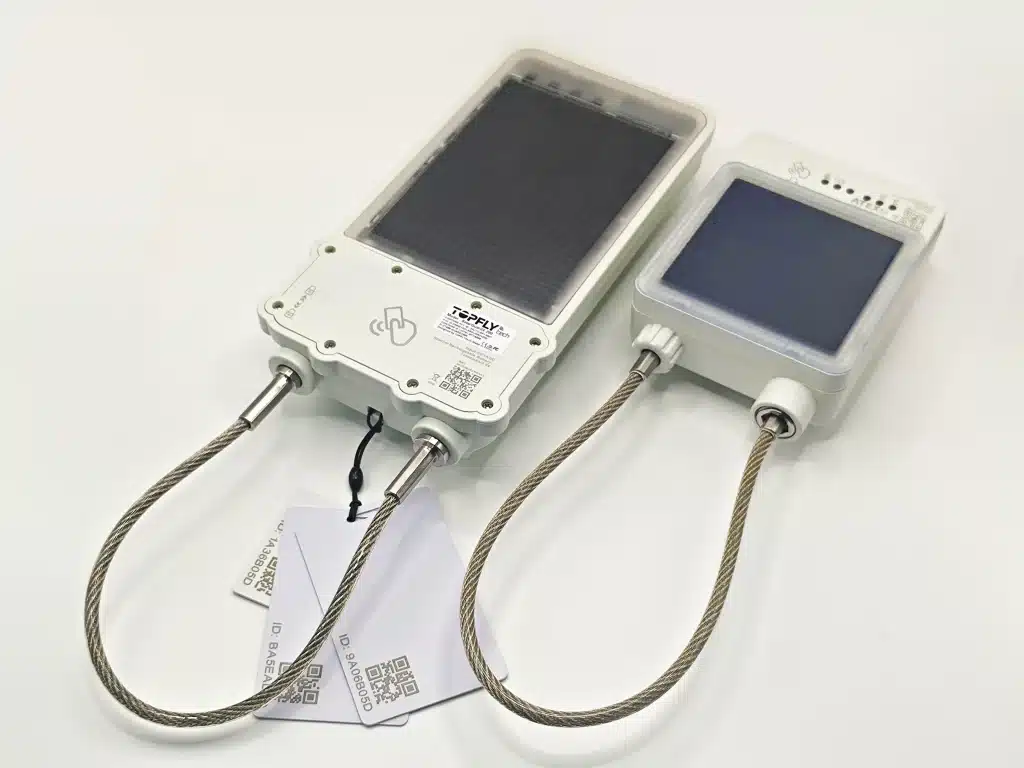
SolarGuardX 120 CB01 is a compact smart lock tracking device designed for small trucks and light commercial vehicles.
It integrates:
- 4G CAT-1 + 2G cellular connectivity
- GPS-based vehicle positioning
- Smart lock status monitoring
- Compact hardware design optimized for small vehicle installation
The device extends smart lock functionality into a vehicle class that is often underserved by container-focused locking systems.
Design Requirement: Smart Locking for Small Truck Logistics
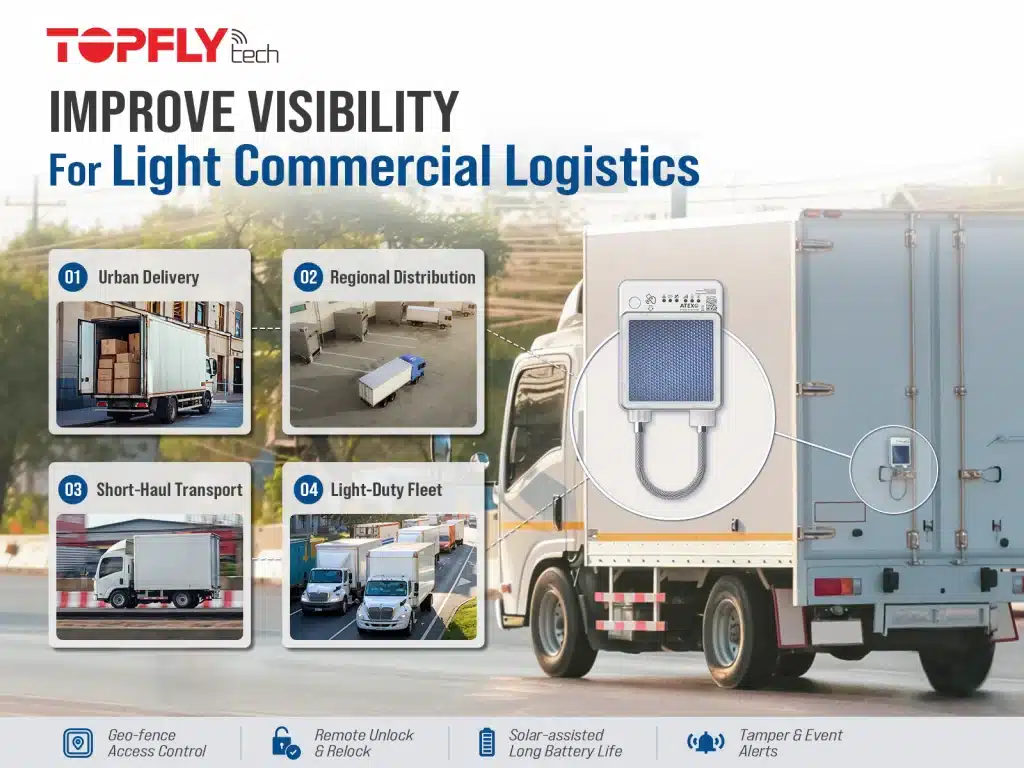
Small-truck logistics typically operates in:
- Urban delivery environments
- Regional distribution networks
- Retail replenishment cycles
- High-frequency short-haul routes
Unlike long-haul freight, these operations require:
- Frequent cargo access events
- Rapid loading/unloading cycles
- High vehicle utilization rates
- Lightweight and scalable hardware deployment
| Product Class | Target Application |
|---|---|
| SolarGuardX 100 / 110 / 200 | Containers, tankers, heavy-duty freight |
| SolarGuardX 120 CB01 | Small trucks, vans, light commercial vehicles |
From a systems engineering perspective, the requirement is not simply “more security”, but appropriately scaled security instrumentation.
This segmentation reflects a principle commonly observed in fleet digitalization systems:
hardware must align with asset class rather than be generalized across all vehicle types.
Engineering Perspective: Why “Right-Sizing” Matters
In fleet telematics and IoT logistics systems, efficiency is not only defined by functionality but also by system-to-asset fit.
Oversized devices may introduce:
- Installation inefficiency
- Increased operational overhead
- Reduced deployment scalability
Undersized systems, on the other hand, may lack necessary visibility or control.
The design objective of SolarGuardX 120 CB01 is to position itself within a balanced operational layer:
between basic mechanical locks and heavy-duty container smart locks
In parallel, research in smart vehicle systems highlights the importance of secure, connected monitoring devices in mitigating risks such as theft, unauthorized access, and cargo tampering during transit.
This intermediate layer corresponds to a growing segment of logistics operations driven by urbanization and regional distribution networks.
The Conclusion
SolarGuardX 120 PN:CB01 extends smart lock tracking capability into a vehicle category that has historically been underserved by container-focused security systems.
Rather than increasing system complexity, it focuses on aligning functionality with operational scale.
These systems typically combine GPS tracking, sensor data, and communication modules into a unified fleet monitoring architecture .