If your fleet “monitors” driver behavior but nothing changes, you do not have a driver behavior monitoring solution. You have noise.
A real driver behavior monitoring solution turns risky moments into clear events, routes them to the right people, and closes the loop with coaching and accountability. This page is the blueprint: what to track, how alerts should work, how to deploy fast, and how to avoid the mistakes that kill adoption.
Want the hardware first? Start here: Portable trackers that can support fleet monitoring setups:
- Portable trackers: https://www.topflytech.com/en/product-category/portable-tracker/
- Accessories (BLE sensors, add-ons, ID options): https://www.topflytech.com/en/accessories/
What a Driver Behavior Monitoring Solution Actually Is
A driver behavior monitoring solution is a workflow, not a dashboard.
It includes:
- Data capture (movement, speed, events)
- Rules (what counts as harsh braking, speeding, etc.)
- Alerts and reporting (real-time and weekly)
- Accountability (who was driving)
- Coaching loop (actions that change behavior)
If any of those five are missing, your “solution” will either spam managers or get ignored by drivers. Usually both.
What to Monitor First: Core Fleet Safety Metrics
Start with the metrics that are easy to explain and hard to argue with. You can expand later.
| Metric | What it usually signals | Why fleets track it | Tuning tip to reduce false positives |
|---|---|---|---|
| Harsh braking | Late reactions, tailgating, distraction | Crash risk, safety coaching | Add a speed gate (ignore at very low speed) |
| Harsh acceleration | Aggressive starts, impatience | Safety + fuel waste | Use minimum duration so bumps do not trigger |
| Harsh cornering | Speeding in turns, load instability | Rollover risk, cargo damage | Adjust for vehicle type (van vs. truck) |
| Speeding | Policy violations, route pressure | Compliance + collision severity | Use road-type thresholds if possible |
| Excessive idling | Fuel waste, engine wear, weak policy | Cost reduction + sustainability | Alert only after a time threshold |
Rule #1: Do not track everything on day one. Track what you will act on.
How a Driver Behavior Monitoring Solution Works
Here is the clean model you should aim for:
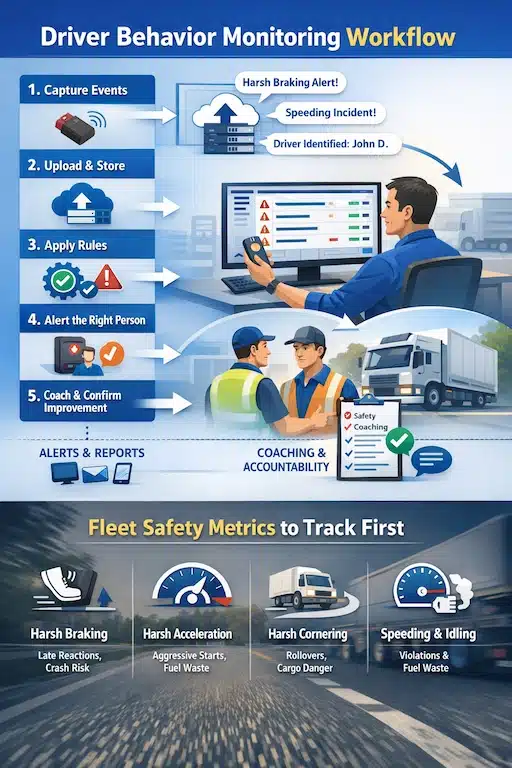
1) Capture events
A portable tracker records motion and speed patterns that can be translated into driving events.
2) Upload and store
Data moves to your platform for analysis and reporting.
3) Apply rules (the “brain”)
Rules translate raw motion into events (braking, acceleration, speeding). This is where most teams fail. They copy generic thresholds, then complain about false positives.
4) Alert the right person
Real-time alerts are for urgent risk. Weekly reports are for trend management. Mixing them creates chaos.
5) Coach and confirm improvement
Events without coaching are just punishment. Coaching without metrics is just feelings.
If you need devices and accessories to build this workflow, these collections are the practical starting points:
- Portable trackers: https://www.topflytech.com/en/product-category/portable-tracker/
- Accessories (BLE sensors / ID add-ons): https://www.topflytech.com/en/accessories/
Deployment Checklist: Pilot to Rollout Without Wasting a Quarter
Use this checklist to deploy a driver behavior monitoring solution in a way that survives reality.
Step 1: Define the outcome
Examples:
- Reduce harsh events by 25% in 6 weeks
- Cut idling time by 15% in 30 days
- Improve safety scores for the bottom 20% drivers
Step 2: Choose the first metrics
Pick the metrics you can coach immediately.
Step 3: Run a pilot with real routes
Use normal operations. Otherwise your rules will break on rollout day.
Step 4: Tune alerts before you scale
The goal is credible alerts, not maximum sensitivity.
Step 5: Define who receives what
- Real-time: safety manager, dispatcher (only critical)
- Weekly: fleet manager, HR/training
- Monthly: leadership summary
Step 6: Lock the coaching loop
- Weekly review meeting
- Driver feedback and context
- Coaching plan
- Follow-up score check
Common Mistakes That Destroy Adoption
Mistake 1: Alert spam
If managers get 200 alerts a day, they will ignore all 200.
Fix: escalate only the events that require same-day action. Report everything else weekly.
Mistake 2: One-size thresholds
A threshold that works for a small van may be wrong for a loaded truck.
Fix: tune by vehicle category and route pattern.
Mistake 3: No driver identification
If multiple drivers use the same vehicle, your data becomes a blame game.
Fix: add a driver identification method (often via accessories). Start exploring options here:
- Accessories: https://www.topflytech.com/en/accessories/
Mistake 4: “Monitoring” without coaching
Drivers will treat it as surveillance and push back.
Fix: frame it as safety improvement, show the metrics, and prove fairness with tuned rules.
Mistake 5: No link to operational reality
If the system ignores traffic, steep grades, and loading conditions, your best drivers will get punished.
Fix: build a dispute process for edge cases during the pilot.
Recommended Setup: What to Use
A practical driver behavior monitoring solution typically needs:
Portable trackers (core event capture)
Use portable trackers when you want flexible deployment and consistent tracking across assets and vehicles.
- Portable tracker collection: https://www.topflytech.com/en/product-category/portable-tracker/
Accessories and add-ons (ID, sensors, operational context)
Driver identification and extra context usually live here.
- Accessories: https://www.topflytech.com/en/accessories/
Cargo security (if theft risk is part of “fleet safety”)
If your fleet safety definition includes cargo integrity and route security, connect the monitoring story to physical security controls.
- GPS E-lock: https://www.topflytech.com/en/gps-e-lock/
Long-life deployments (where maintenance access is limited)
If you have assets exposed to sunlight and want less maintenance overhead, solar tracking can fit certain scenarios.
- Solar-powered asset tracker: https://www.topflytech.com/en/solar-powered-asset-tracker
FAQ
What is the difference between driver behavior monitoring and driver behavior tracking?
Driver behavior monitoring focuses on alerts and workflow actions. Driver behavior tracking focuses on collecting and analyzing behavior patterns over time. A good solution does both, but monitoring is what changes outcomes.
What should fleets track first?
Start with harsh braking, harsh acceleration, speeding, and idling. Add cornering after you have stable thresholds and buy-in.
How do you reduce false positives?
Use speed gates, minimum durations, and pilot-based tuning. Generic thresholds copied from the internet usually fail.
Do I need OBD for a driver behavior monitoring solution?
Not always. Many fleets start with motion and location signals. OBD can add vehicle context when needed.
Why is driver identification important?
Without driver identification, coaching becomes unfair and accountability becomes blurry. If multiple drivers share vehicles, ID becomes a priority.
How long does deployment take?
A pilot can run in weeks. Full rollout depends on fleet size, training cadence, and how quickly you tune rules.
Next Step: Turn This Guide Into Your Setup
If you are building a driver behavior monitoring solution and want to map it to real hardware categories, start with these product collections and work backward into your workflow:
- Portable trackers: https://www.topflytech.com/en/product-category/portable-tracker/
- Accessories (driver ID, BLE sensors, add-ons): https://www.topflytech.com/en/accessories/
- Cargo security option: https://www.topflytech.com/en/gps-e-lock/