In real-world operations, cost is rarely driven by “battery capacity” itself. It’s driven by recurring human work: checking devices, planning maintenance, troubleshooting blind spots, and sending someone on-site when something goes wrong.

Low power isn’t just “longer battery life”
A bigger battery can extend runtime on paper. But it does not automatically reduce cost.
Low-power design is different. It’s an engineering approach that reduces how much energy the device spends on the things that quietly drain batteries in the field. In cellular IoT deployments, many power-efficiency behaviors are tied to network and device sleep/wake patterns standardized in 3GPP specifications (for example, power-saving features commonly referenced as PSM/eDRX).
- network registration and reconnection
- location fixes under weak GNSS conditions
- unnecessary wake-ups and reporting overhead
- retries caused by poor signal environments
The outcome isn’t just “more days.” It’s fewer maintenance events and fewer exceptions that force your team to intervene.
Where operational costs really come from (and why teams underestimate them)
In many deployments, hardware cost is not what hurts. The operational cost comes later, and it shows up as repeated friction:
1) Field visits and coordination
If a tracker is deployed across yards, depots, customer sites, or remote locations, every maintenance cycle becomes a scheduling problem.
- dispatching staff (or contractors) for battery replacement / recharge
- access coordination with site owners
- missed visits that turn into delayed fixes
- handling and shipping considerations when you move or replace lithium batteries (see FAA lithium battery safety guidance)
2) Downtime and blind spots
When a device goes offline unexpectedly, you don’t just “lose data.” You lose operational confidence.
Teams then compensate by adding manual checks, creating spreadsheet workarounds, or lowering alert thresholds—none of which are free.
3) Troubleshooting overhead
Low battery events often look like “random” failures to non-technical teams: missed pings, intermittent updates, false alarms, or missing trips.
Even when each incident is manageable, the cumulative load becomes real—especially as you scale from dozens of assets to hundreds or thousands.
Why predictability reduces cost more than capacity
A high-capacity device may last longer in ideal conditions. But if it still requires frequent attention (or fails unpredictably), the operational burden remains.
Low power asset tracking design matters because it improves predictability:
- more stable reporting cadence
- fewer unexpected offline periods
- maintenance that can be planned instead of “reacted to”
And predictability is what allows an operations team to run lean: fewer urgent site visits, fewer escalations, and fewer exceptions that break daily workflows.
When low-power asset tracking matters most
Low-power design becomes especially valuable when your assets are:
- remote (the cost of a visit is high)
- outdoor (signal and temperature conditions vary)
- idle for long periods (trailers, containers, equipment)
- hard to access (restricted sites, customer locations, yards)
In these environments, the best tracker should be the one that can run unattended with the fewest human interventions.
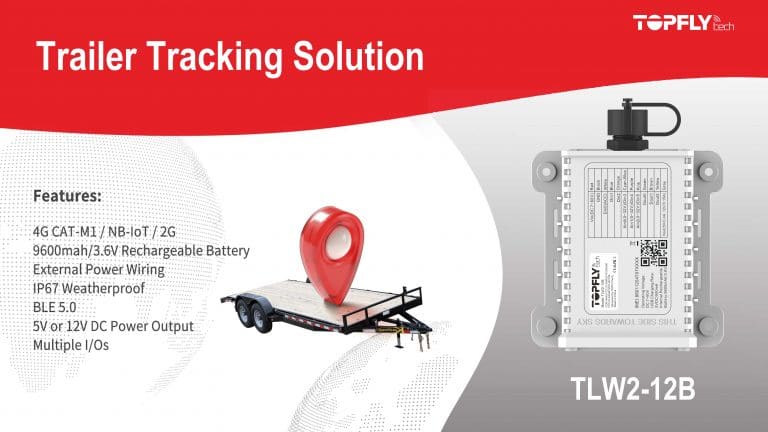
If your assets include trailers or similar non-powered equipment, this is where a dedicated solution approach is often useful. See the TOPFLYtech trailer tracking solution page for typical deployment scenarios.
How to evaluate operational cost
If you want to choose devices based on operational cost (not just spec sheets), ask these practical questions:
What is a maintenance event worth in your operation?
Include labor time, travel time, access coordination, and the cost of delayed fixes.
How does reporting frequency change your real maintenance cycle?
Most teams discover that the reporting interval they want for visibility is not the interval that maximizes battery life. This is a useful place to model scenarios. TOPFLYtech provides a battery life calculator to estimate how different settings affect runtime.
How much offline time can you actually tolerate?
If your process depends on alerts and visibility, offline time becomes an operational risk—even if it happens only sometimes.
Conclusion: make a cost-control strategy on low power asset tracking
Low power is not just a technical feature.
It is a design strategy that prioritizes stability, predictability, and operational efficiency—because in asset tracking, cost is not defined by how much energy a device uses.
Cost is defined by how often people need to get involved.
If you’re planning or scaling a deployment, start with the workflow and the maintenance reality—not the battery number on the spec sheet. You can also explore TOPFLYtech’s asset tracking overview to align device choice with real operating conditions.