WiFi Positioning: That Happens When GPS Goes Quiet
For years, positioning discussions started with GPS accuracy. Meters. Satellites. Clear sky.
But the recent rise in searches for WiFi accuracing tells a different story. People aren’t asking because GPS suddenly got worse. They’re asking because, in real deployments, GPS disappears more often than anyone likes to admit.
Indoor assets, urban canyons, underground parking, port warehouses, and increasingly, low-power devices that simply cannot afford to keep GPS awake all the time. That’s where WiFi positioning quietly steps in—not as a hero, but as a safety net.
Why “WiFi Positioning” Is Trending Again
Most tracking systems work beautifully… until they don’t. In 2026, three things are happening at the same time:
- Tracking environments are getting tougher
Indoor logistics, dense cities, mixed-use infrastructure—places where satellite signals struggle by design. - Devices are expected to last longer
Battery-powered trackers are no longer niche. Power budgets are tight, and GPS is expensive. - Data continuity matters more than pinpoint accuracy
For many operations, a reasonable location now beats a perfect location later.
When GPS drops out, systems need something that still works, which is often WiFi positioning.
WiFi Positioning Is Not a GPS Replacement — It’s a Data Safety Net
Let’s get one thing straight. WiFi positioning is not here to replace GPS, but its real job is simpler—and more important:
Keep location data alive when GPS goes quiet.
Think of it this way:
- GPS is the primary signal
- LBS provides a broad fallback
- WiFi positioning fills the gap where neither precision nor power allows GPS to stay on
In practice, WiFi positioning reduces blind spots. Not by being perfect—but by being available, and availability is underrated until the data goes missing.
WiFi Triangulation: Accuracy Depends on Context, Not Theory
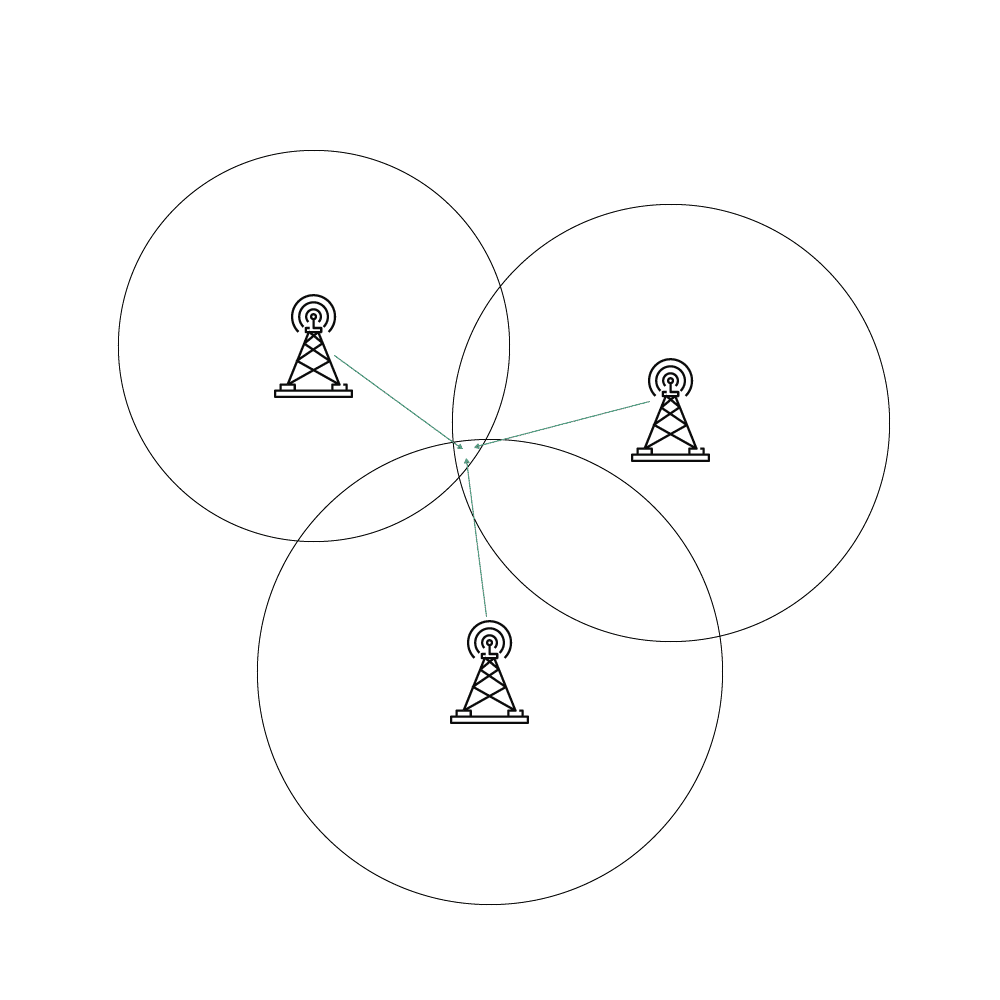
WiFi triangulation sounds mathematical. In reality, it’s environmental. The principle is straightforward:
A device scans nearby WiFi access points and estimates its position based on known AP locations and signal characteristics. What actually determines performance is not the algorithm—it’s the surroundings:
- High AP density (cities, offices, malls) → stronger results
- Sparse or private networks → limited benefit
- Dynamic environments → constantly shifting accuracy
This leads to an uncomfortable but honest truth:
In WiFi triangulation, the map matters more than the math.
That’s why it performs best where people already are—and struggles where infrastructure is thin.
Where WiFi Positioning Quietly Saves the Day
WiFi positioning rarely gets credit because it usually works in the background.
Some real-world moments where it matters:
- Indoor assets in warehouses
GPS never locks, but WiFi fingerprints still place the asset within the facility. - Urban fleet operations
Vehicles moving through dense city blocks experience GPS dropouts, while WiFi keeps location data continuous. - Underground or semi-covered parking areas
No sky view, but plenty of access points. - Low-battery scenarios
When GPS is throttled to preserve power, WiFi scans offer a lighter alternative.
In these cases, WiFi positioning doesn’t shout.
It simply prevents the system from going silent.
Why WiFi + LBS Still Matters for Low-Power Tracking
Battery-powered tracking changes the rules.
Continuous GPS polling is no longer the default—it’s a luxury.
WiFi positioning and LBS together offer a practical compromise:
- Lower power consumption
- Acceptable location resolution
- Fewer gaps in historical data
For many deployments, this isn’t a downgrade.
It’s a smarter allocation of energy.
Because a tracker that lasts longer—and reports consistently—often delivers more value than one that’s ultra-precise but short-lived.
From Positioning to Confidence
At the system level, customers rarely ask for “WiFi triangulation.”
What they ask for is:
- Why did the tracker disappear here?
- Can we explain this location gap?
- Can we trust the movement history?
WiFi positioning doesn’t answer every question.
But it reduces uncertainty.
And in modern tracking systems, confidence is just as important as coordinates.
That’s why WiFi positioning is no longer treated as a feature—it’s part of a resilience strategy.
Quiet. Practical. And increasingly essential.