Fleet telematics has already gone through one big shift: from manual vehicle oversight to GPS-based location visibility. The next shift is about context. Knowing where the vehicle is remains important, but it no longer answers the full set of questions fleet operators care about. Was the driver distracted? Was the event caused by harsh behavior, fatigue, or unsafe following distance? Was there enough evidence to verify what actually happened?
That is where AI vision and video telematics are changing the conversation. The goal is not just to record more footage. The goal is to turn road events, driver behavior, and operational exceptions into evidence that managers can actually act on.
Why Location Data Alone Stops Short
Traditional GPS telematics is very good at answering location-based questions. It can show where a vehicle traveled, when it stopped, whether it deviated from the route, and in many cases how fast it was moving. But when a fleet needs to understand why an incident happened or whether a risky behavior occurred in the cab, location data reaches its limit.
That gap appears in situations such as:
- disputed accident responsibility,
- coaching drivers after repeated harsh events,
- verifying distraction, fatigue, or unsafe habits,
- and reviewing customer complaints or insurance-related incidents.
In those moments, fleets need more than a dot on a map. They need context around the event itself.
What AI Vision Adds to Fleet Telematics
AI-enabled video telematics closes that context gap by combining telematics data with what is happening around the driver and the road. In practical terms, this usually means a fleet gains better visibility into:
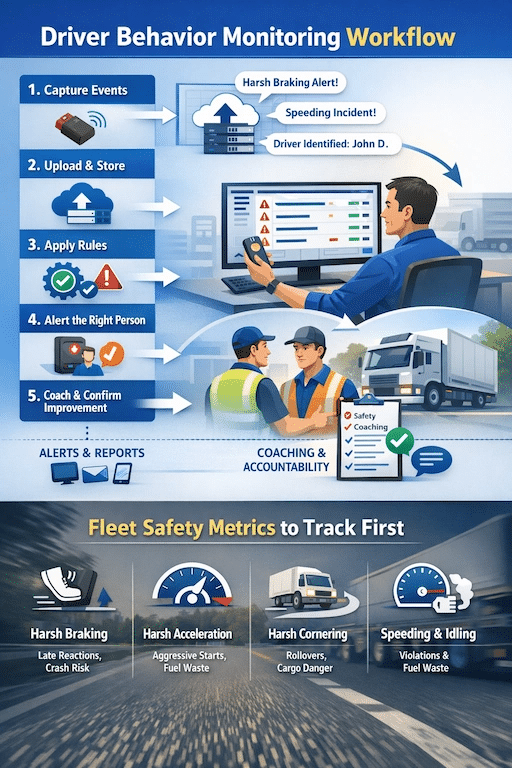
- driver behavior: harsh driving, distraction, fatigue, and other risky patterns become easier to review and coach,
- incident evidence: video records help clarify what happened before, during, and after an event,
- operational accountability: managers can investigate with more confidence instead of relying on partial reports,
- safety improvement loops: fleets can move from passive reporting to active coaching and policy enforcement.
This is why video telematics is rarely a total replacement for GPS tracking. It is better understood as an upgrade path from “where is the vehicle?” to “what risk is developing and what evidence do we have?”
For the solution-side view, the Driver Behavior Monitoring Solution is the clearest bridge between telematics data and safety action.
When Fleets Usually Outgrow GPS-Only Visibility
Many fleets start with location, speed, and route history because those are the easiest problems to quantify. But over time, a more expensive class of questions appears:
- Why are accidents still happening even though routes are visible?
- Which risky drivers need coaching before claims increase?
- How do we defend against disputed events without usable evidence?
- How do we connect unsafe behavior to the individual behind the wheel?
That is usually the point where GPS-only telematics begins to look incomplete. The fleet does not necessarily need to throw away its tracking stack. It needs to add a stronger event, behavior, and accountability layer.
What Buyers Should Evaluate Before Expanding Into Video Telematics
Not every fleet should jump straight to the same setup. Before adding AI vision, buyers should usually check:
- risk profile: Are claims, unsafe behavior, disputed incidents, or coaching gaps becoming material business problems?
- vehicle type and installation model: Hardwired fleets often have more room for integrated telematics and peripheral logic than simpler plug-and-play deployments.
- driver accountability workflow: Is the goal only to capture events, or also to identify the specific driver and act on the result?
- response process: Who reviews events, how quickly they are handled, and how findings feed back into safety management?
These questions matter because video telematics works best when it supports a management process, not just a hardware purchase.
Recommended Hardware for This Use Case
For fleets moving from basic tracking toward behavior visibility and stronger accountability, a lightweight recommended stack usually looks like this:
- HeroX 100 — a good fit when the fleet needs a hardwired tracker with broader I/O and BLE accessory support for more customized telematics workflows.
- PioneerX 101 — suitable for fleets that want a modern hardwired vehicle-tracking foundation before layering in more safety or driver-management logic.
- Driver Behavior Monitoring Solution — the best path when the immediate goal is to reduce risky driving, improve coaching, and make telematics data operationally actionable.
- Driver Identification Solution — useful when fleets also need to tie behavior, trip history, and exceptions back to the right individual behind the wheel.
This is not meant to turn the article into a product page. It is simply the clearest next step for readers who already know their problem is no longer just vehicle location.
How This Changes Safety and Operations
The biggest benefit of AI vision is not that it produces more data. It is that it makes telematics more usable in the moments that matter. Fleets can investigate events faster, coach drivers with better evidence, reduce argument over what happened on the road, and connect safety management more directly to operational accountability.
In other words, video telematics turns fleet visibility from a map function into a decision function.
Next Step for Fleets Evaluating the Upgrade
If your current stack is still mostly GPS-based, start with the Driver Behavior Monitoring Solution to understand the operational layer first. If you are comparing hardware fit, review HeroX 100 and PioneerX 101. If identifying the person behind the wheel is part of the problem, continue to the Driver Identification Solution. And if you want help matching the right stack to your fleet profile, contact TOPFLYtech for a more practical discussion.