Low temperature does not only affect the cargo inside a refrigerated truck, but also affect the devices that are supposed to monitor that cargo.
For cold chain operators, this is an easy detail to miss. The reefer is working. The route is planned. The temperature sensor is installed. The tracker is reporting. Everything looks fine — until the device battery drains faster than expected, the reporting interval becomes unreliable, or a temperature event is discovered too late.
That is why battery performance should be part of cold chain planning, not an afterthought.
Cold chain visibility is not just about knowing whether the cargo stayed cold. It is also about knowing whether the monitoring system can keep working under the same cold conditions.
Cold Chain Monitoring Not Just a Sensor
In real cold chain operations, temperature monitoring usually depends on several moving parts:
- a temperature or humidity sensor inside the refrigerated space;
- a tracker, gateway, or BLE hub that receives the sensor data;
- cellular or wireless communication;
- a platform that stores alerts, reports, and trip history;
- power management that keeps the hardware alive throughout the journey.
If one part becomes weak, the whole visibility chain becomes weaker.
This matters because refrigerated transport can involve long routes, door-open events, loading delays, warehouse handovers, customs checks, and idle time. A sensor may be technically accurate, but if its battery performance is not suited to the operating environment, the business still has a blind spot.
For food transport, the FDA’s sanitary transportation rule focuses on practices that help ensure food is transported safely. For pharmaceutical logistics, WHO guidance also treats time- and temperature-sensitive products as a controlled storage and transport responsibility, not a casual best-effort process.
Now the quiet lesson is simple: temperature control needs records, and records need devices that stay alive.
Why Low Temperature Changes the Battery Conversation
Battery-powered IoT devices are often evaluated under “normal” assumptions: expected reporting interval, signal quality, battery size, firmware settings, and estimated trip duration.
Cold chain logistics breaks that comfort zone.
In cold chain battery life, low temperature can reduce battery performance because electrochemical reactions slow down and internal resistance can increase. NREL also notes that lithium-ion battery performance is lower in cold and hot environments, which is why temperature should be considered when planning battery-powered systems.
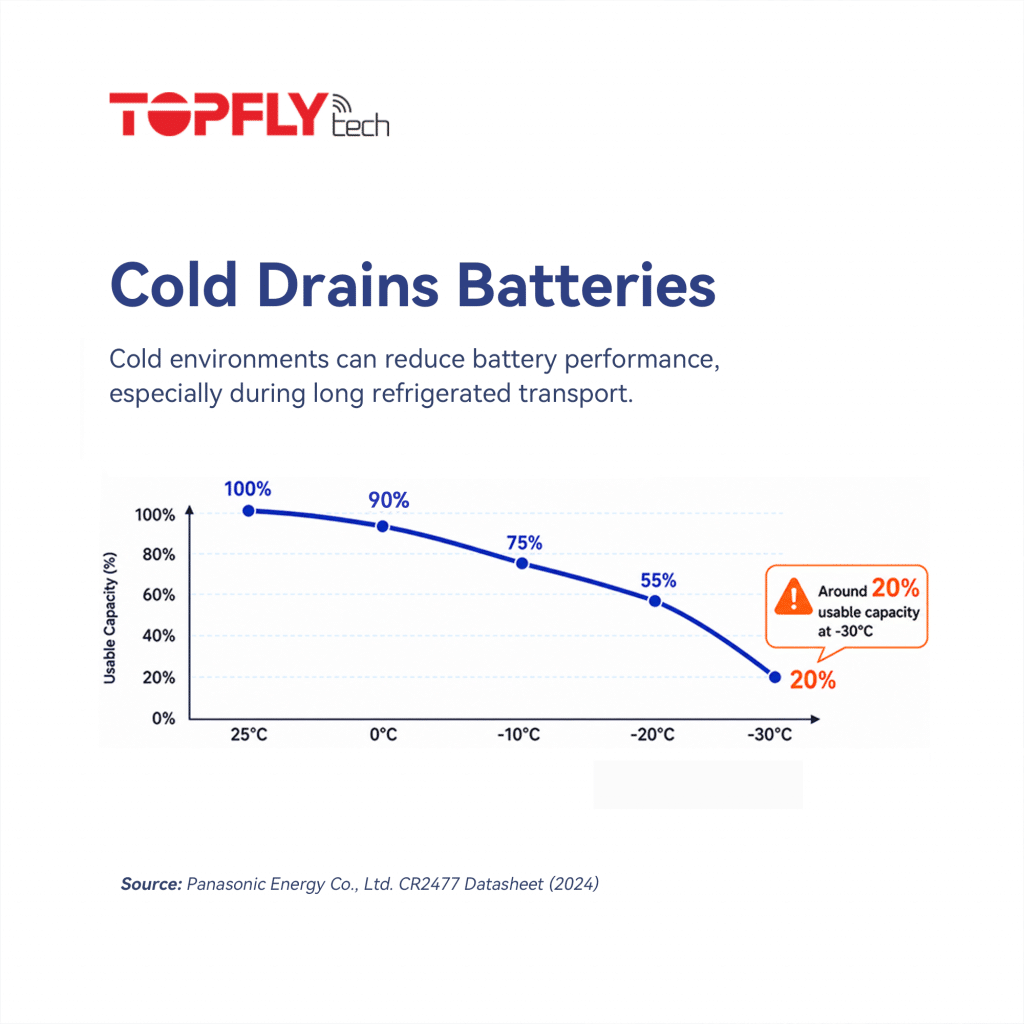
For a cold chain fleet, this does not mean every device will suddenly fail in cold conditions. That would be dramatic, and logistics already has enough drama. It means the deployment plan should avoid assuming that battery behavior in a refrigerated route will match battery behavior in a mild office test.
The practical question is not:
“What is the battery capacity?”
The better question is: “Under this temperature, reporting frequency, trip length, signal condition, and alert logic, will the device still behave the way our operation needs?”
The Hidden Battery Drains in Refrigerated Transport
Low temperature is only one part of the story. In cold chain operations, cold chain battery life is often affected by a combination of factors.
1. Reporting frequency
Frequent reporting gives better visibility, but it also consumes more power. A device that reports often during a long refrigerated trip will behave very differently from one that only sends periodic status updates.
For high-value cargo, frequent reporting may be justified. For lower-risk shipments, a smarter interval may protect battery life without sacrificing useful visibility.
2. Signal quality
Cold chain routes often pass through loading bays, warehouses, rural roads, ports, border areas, and underground or shielded environments. Poor signal conditions can increase power consumption because the device may spend more effort trying to connect or transmit.
This is why battery life cannot be judged only by battery capacity. Network behavior can quietly eat the lunch. No invitation, just vibes.
3. Door-open events
Door openings are operationally important in cold chain logistics. They can indicate loading, unloading, inspection, unauthorized access, or temperature exposure risk.
But every event-based alert also creates power activity. If door status, temperature readings, and tracking reports are all configured aggressively, battery planning needs to reflect that.
4. Idle time
Cold chain assets do not always move continuously. Trailers, containers, and mobile refrigeration units may sit in yards, warehouses, or transfer points.
During idle time, a monitoring device may still wake up, check status, scan sensors, wait for motion, or send heartbeat messages. A stationary asset is not automatically a silent asset.
5. Temperature sampling logic
Temperature monitoring is not only about the sensor’s accuracy. It is also about how often temperature is sampled, how data is transmitted, and when alerts are triggered.
A smarter sampling and alert strategy can protect both visibility and battery life.
A Note for Cold Chain Teams
For cold chain operators, the business value of cold chain battery life is not in adding a sensor. The more valuable thing is in building a monitoring setup that fits the route, cargo, and risk profile.
Before deploying devices, teams should ask:
- How cold will the environment be during normal operation?
- How long will the trip or storage period last?
- How often does the business actually need location updates?
- Which events require immediate alerts?
- What happens if the device misses a report?
- Is the device inside the refrigerated space, outside the compartment, or near the door?
- Does the team need proof-of-condition records after delivery?
These questions are boring in the best possible way, but prevent expensive surprises.
Where T-one Fits in This Conversation
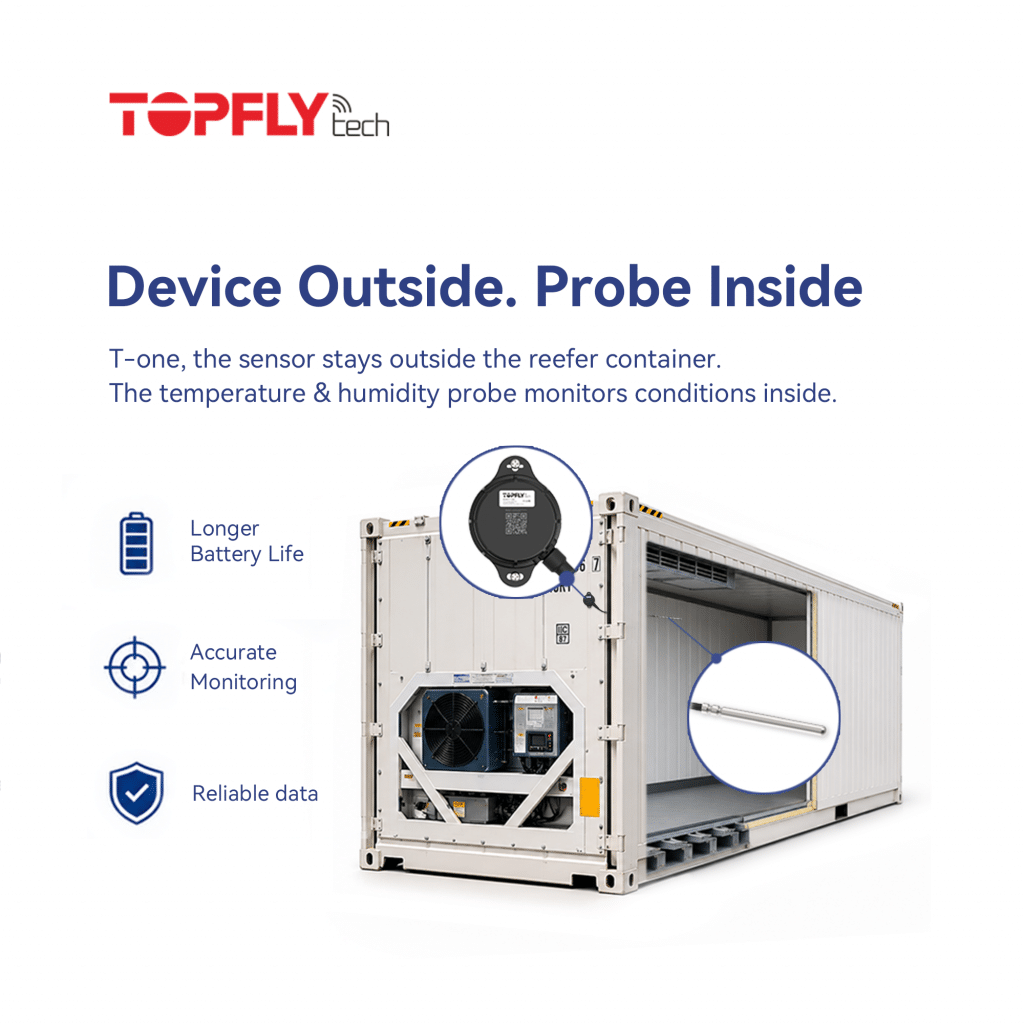
TOPFLYtech’s T-one is designed for temperature and humidity monitoring and transmits data via BLE to compatible trackers or a BLE hub. It is positioned for environmental monitoring use cases where temperature changes need to be captured and transmitted reliably.
In cold chain applications, a BLE temperature sensor like T-one can help teams monitor the environment around goods without relying only on vehicle-level assumptions. That distinction matters.
A reefer unit may show that the refrigeration system is running. But a sensor placed closer to the cargo area can provide more relevant environmental visibility.
This is especially useful when teams need to understand:
- whether temperature remained stable during transit;
- whether door openings affected cargo conditions;
- whether storage or loading areas created exposure risk;
- whether temperature history can support delivery review or customer communication.
The product should not be treated as magic. It is a tool. The real value comes from placing it correctly, configuring it sensibly, and connecting it to a tracking workflow that the team actually uses.
Battery Planning Should Happen Before Deployment
A common mistake is to choose a device first and discuss battery life later.
For cold chain projects, reverse the order.
Start with the operating conditions:
- cargo type;
- trip duration;
- temperature range;
- reporting interval;
- alert rules;
- route signal quality;
- installation position;
- required records after delivery.
Then match the monitoring device and reporting strategy to that reality.
TOPFLYtech also provides a battery life calculator for GPS trackers and IoT devices, which can help teams compare runtime assumptions and plan battery-powered deployments more realistically.
A calculator is not a replacement for field testing. But it is a good way to stop guessing in the dark with a flashlight that also has low battery.
The Real Risk Is False Confidence, Not Cold.
Regarding cold chain battery life, the teams already know temperature matters. The missed detail is that the monitoring system lives in the same harsh environment as the cargo.
If a battery-powered sensor or tracker is deployed without considering low temperature, power consumption, reporting logic, and installation position, the operation may look visible while quietly becoming blind.
A better cold chain monitoring strategy treats battery performance as part of visibility. Not a footnote. Not a spec-sheet afterthought. Part of the operating plan.