BLE relays look simple on the surface: receive a wireless command and switch a circuit on or off. But in telematics and fleet operations, that simple action can support much bigger workflows — anti-theft control, remote immobilisation, access authorization, refrigeration logic, and event-driven automation without long control wiring.
That is why a BLE relay is not just a convenience accessory. In the right deployment, it becomes the practical bridge between tracking logic and physical vehicle control.
What a BLE Relay Actually Does
A BLE relay receives a nearby Bluetooth Low Energy command from a compatible tracker or hub and changes the state of a connected circuit. In most real deployments, that means the relay sits close to the circuit being controlled while the tracker or gateway handles the communication and rule logic.
Typical controlled targets include:
- ignition lines,
- fuel pump or immobilisation logic,
- door or compartment release,
- auxiliary power equipment,
- cold-chain or service-specific on/off control tasks.
The point is not wireless control for its own sake. The point is to reduce wiring complexity while still allowing the platform and tracker to trigger useful physical actions.
Why Fleets Use BLE Relay Instead of Heavier Wiring Logic
In vehicles and mobile assets, installation complexity matters. Long control wires increase labor, create more exposure to tampering, and make retrofits slower. A BLE relay helps simplify that problem.
Compared with more wiring-heavy approaches, fleets usually value BLE relays because they can support:
- cleaner installation in existing vehicles,
- easier concealment for anti-theft logic,
- short-range stable communication with the nearby tracker,
- more flexible placement in cabins, engine bays, trailers, or compartments.
That is why BLE relay is usually discussed as part of a system design, not as a standalone component decision.
Where BLE Relay Creates the Most Operational Value
BLE relays are most useful when the fleet needs to move from passive visibility to controlled action. Common examples include:
- vehicle anti-theft workflows that require controlled immobilisation,
- driver authorization logic where the right person or credential needs to be confirmed before action is allowed,
- fleet fuel and auxiliary control where switching logic supports more structured operations,
- specialized equipment control for trailers, service vehicles, or refrigerated assets.
This is why the relay article should not stop at “how it works.” It should also connect the component to the actual use cases that make the component worth installing.
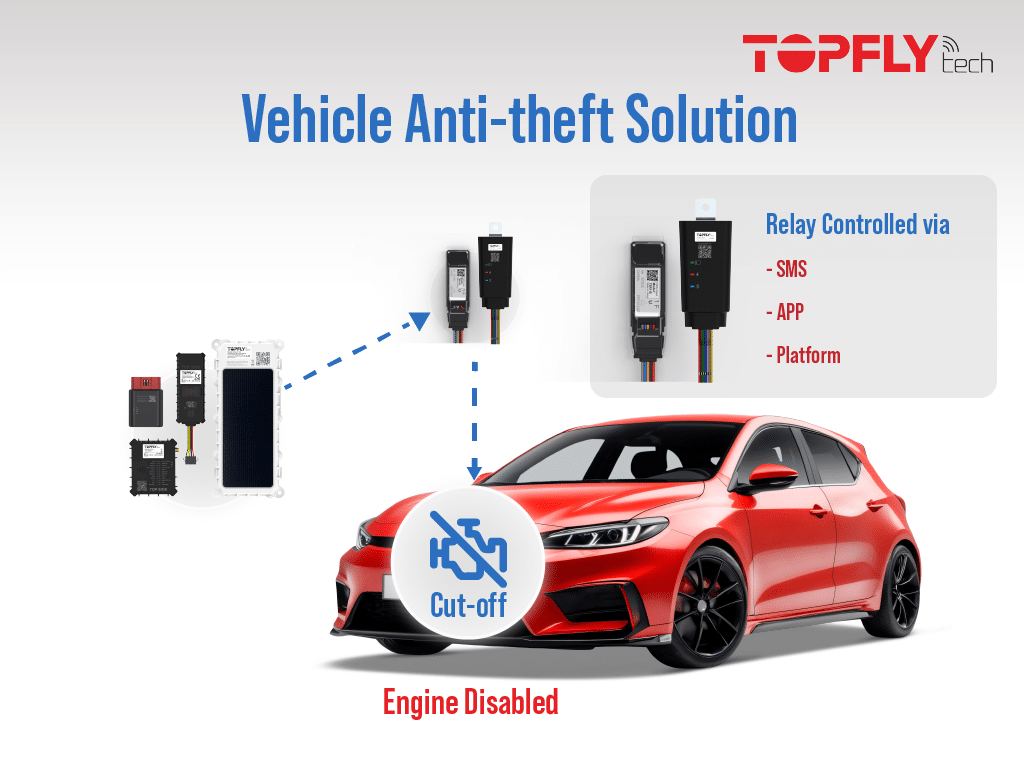
For example, the Vehicle Anti-theft Solution shows why relay-based control matters in theft prevention, while the Driver Identification Solution shows how access and control logic can be connected to the person behind the wheel.

TSR1-B and T-Relay: Why the Product Choice Depends on the Workflow
Not every BLE relay deployment needs the same hardware path. Buyers should usually choose based on the control workflow, installation environment, and the tracker logic already in place.
- TSR1-B Wireless Relay fits use cases where a compact BLE relay is needed as part of a telematics-driven control chain.
- T-Relay Wireless Relay is better viewed as part of a broader accessory and control ecosystem for wireless actuation scenarios.
The practical buying question is not “Which relay is more advanced?” It is “Which relay fits the control problem we are solving and the tracker architecture we already use?”
Recommended Hardware for This Use Case
If the goal is to move from simple vehicle tracking into wireless control and action workflows, this is the most practical lightweight stack to review:
- TSR1-B Wireless Relay — the clearest starting point when a BLE relay is needed for remote switching inside a telematics workflow.
- T-Relay Wireless Relay — useful when the deployment needs a flexible wireless relay option connected to BLE-based control logic.
- Vehicle Anti-theft Solution — the best path if relay control is being considered for immobilisation and theft prevention.
- Driver Identification Solution — the more relevant path if the control logic needs to be connected to driver authorization and accountability.
For fleets where relay logic intersects with fuel-control workflows, the Fleet Fuel Monitoring Solution is another useful adjacent reference.
The Practical Takeaway
A BLE relay is not only a wireless switch. In the right telematics design, it becomes the physical action layer that allows tracking systems to do more than observe. It can help fleets prevent theft, authorize usage, control auxiliary functions, and reduce installation complexity at the same time.
That is why the real value of a BLE relay should be judged by the workflow it unlocks, not by the relay component alone.
Next Step for Fleets Evaluating Wireless Control
If the priority is relay-based anti-theft control, start with the Vehicle Anti-theft Solution. If driver authorization is part of the same requirement, continue to the Driver Identification Solution. If you are comparing component options first, review TSR1-B Wireless Relay and T-Relay Wireless Relay. And if you want help matching the right relay path to your fleet control logic, contact TOPFLYtech for a deployment-specific recommendation.