Why Do Similar GPS Trackers Have Different Prices?
When comparing GPS trackers, it’s common to find two products that appear remarkably similar.
Both support 4G LTE, and GNSS positioning. Both have comparable battery capacity, even they offer similar installation methods.
Yet one may cost noticeably more than the other.
Price differences can come from many factors, including hardware design, certifications, communication modules, environmental protection, and manufacturing standards. One specification that is often overlooked—but can significantly influence deployment flexibility—is LTE band support.
While LTE bands may seem like a small technical detail on a specification sheet, they can determine whether a tracker is suitable for a single market or capable of supporting projects across multiple countries.
What Are LTE Bands?
LTE (Long-Term Evolution) is the global standard for 4G cellular communication.
Although LTE is used worldwide, there is no single universal LTE frequency.
Instead, mobile network operators deploy LTE services using different frequency bands defined by the 3rd Generation Partnership Project (3GPP).
Each LTE band represents a specific frequency range licensed for mobile communication.
For example, some commonly used LTE bands include:
| Country | Examples of Common LTE Bands* |
|---|---|
| Germany | B1 · B3 · B20 |
| United States | B2 · B4 · B12 · B13 |
| Brazil | B3 · B7 · B28 |
*Examples only. Actual LTE bands vary by mobile operator and deployment region.
This means that a GPS tracker designed for one market may not offer the same compatibility in another without supporting the appropriate LTE bands.
Why LTE Band Compatibility Matters
LTE compatibility isn’t simply about whether a tracker supports 4G.
It’s about whether the device supports the LTE bands used by the mobile networks where it will actually operate.
For local deployments within a single country, this may not always be a concern.
However, for international logistics, fleet management, container tracking, equipment monitoring, or asset visibility projects spanning multiple regions, LTE compatibility becomes much more important.
Broad LTE band support can help provide:
- Greater compatibility with mobile operators
- Simplified deployment across multiple countries
- Reduced hardware variation for different regions
- Greater flexibility for future expansion
Mobile network deployments differ around the world because spectrum allocation and operator licensing vary by country. The GSMA regularly publishes reports and insights on global mobile network development.
Rather than treating LTE bands as another specification on a datasheet, they should be viewed as part of the overall deployment strategy.
Beyond the Datasheet
Two GPS trackers may both advertise:
- 4G LTE
- GNSS positioning
- Bluetooth
- IP67 protection
At first glance, they appear almost identical.
However, when comparing their LTE specifications more closely, an important difference may emerge.
One device may support only the LTE bands commonly used within a specific region.
Another may support a much broader range of LTE bands, allowing the same hardware platform to operate across North America, Europe, Latin America, Asia-Pacific, and other regions.
Both devices support LTE.
But their deployment flexibility can be very different.
What Happens When LTE Bands Don’t Match?
If a tracker does not support the LTE bands provided by the local mobile operator, several deployment challenges may arise.
These can include:
- Difficulty connecting to the preferred mobile network
- Limited compatibility with available operators
- Additional regional hardware versions
- Increased inventory complexity
- Additional validation before deployment
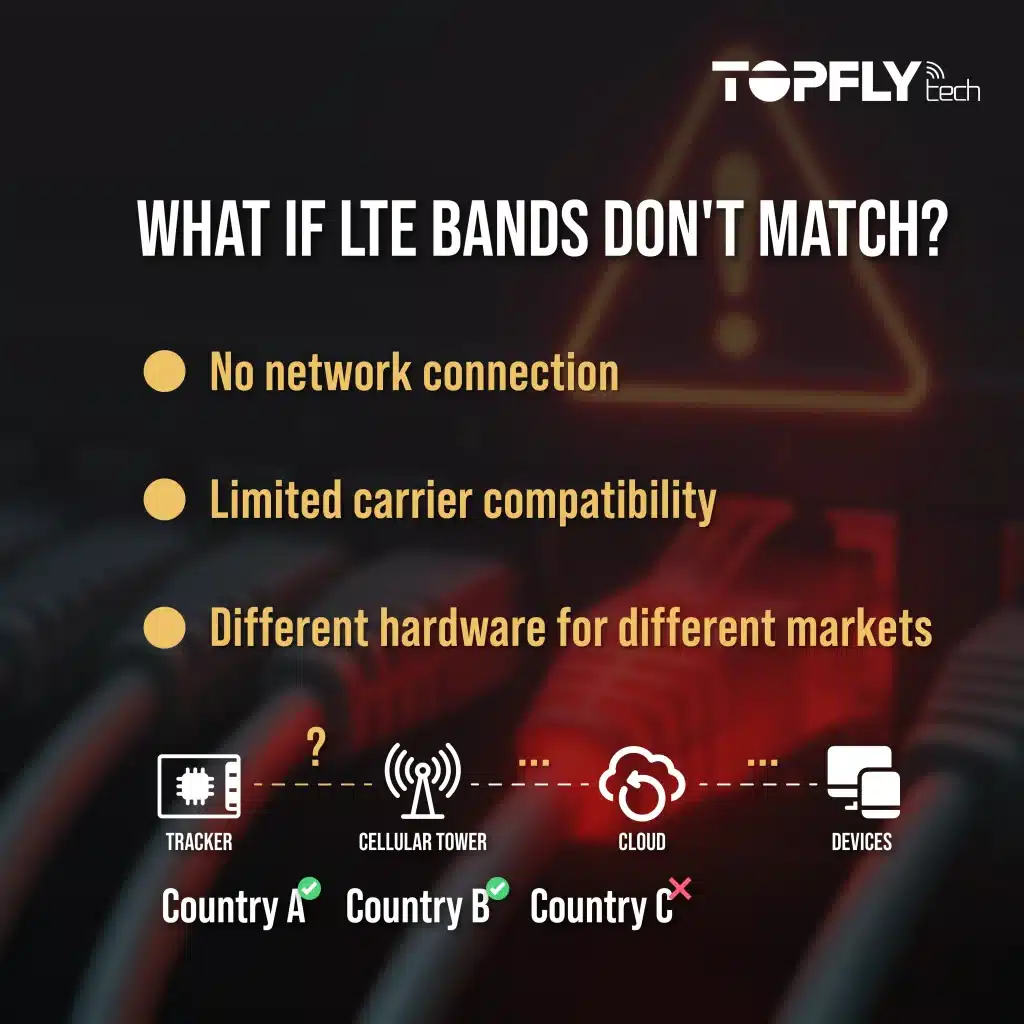
For organizations managing international deployments, these challenges can quickly increase operational complexity.
A Simple LTE Compatibility Checklist
Before selecting a GPS tracker for a multi-country project, it’s worth spending a few minutes checking LTE compatibility.
1. Identify the deployment countries
List every country where the devices are expected to operate.
2. Review local mobile operators
Different operators within the same country may support different LTE bands.
3. Compare supported LTE bands
Review the LTE specifications of the GPS tracker and compare them with local network requirements.
4. Plan for future expansion
Even if deployment begins in one country, consider whether the same hardware may later be used elsewhere.
Selecting broader LTE compatibility today can reduce future hardware changes.
How TOPFLYtech Approaches Global Deployment
Many TOPFLYtech GPS tracking products are designed with broad LTE band support to help simplify international deployment.
Instead of optimizing hardware for only one region, many models support a wide range of LTE bands across multiple markets, helping reduce the need for separate hardware versions when projects expand internationally.
To help customers verify compatibility before deployment, TOPFLYtech also provides an online Network Coverage Map, where LTE band information can be reviewed by country.
The information is updated periodically and can serve as a practical reference during project planning.
Frequently Asked Questions
Does every 4G GPS tracker work worldwide?
No. Supporting 4G LTE does not automatically mean a device supports every LTE band used around the world.
Why do some GPS trackers have different regional versions?
Different hardware versions are often designed to support different LTE band combinations required by different markets.
Can broader LTE band support simplify deployment?
In many international projects, broader LTE compatibility can reduce the need for multiple regional hardware versions and provide greater deployment flexibility.
Where can I check LTE bands before deployment?
You can compare product specifications with local operator requirements and use tools such as the TOPFLYtech Network Coverage Map as a deployment reference.
Final Thoughts
Battery capacity, positioning accuracy, and enclosure ratings are all important when evaluating a GPS tracker.
However, LTE band compatibility is one specification that deserves equal attention—especially for projects expected to operate across multiple countries.
Understanding LTE bands early in the planning process can help reduce deployment complexity, improve network compatibility, and make future expansion much easier.
Sometimes, the most valuable specification isn’t the one that’s advertised the most—it’s the one that prevents problems before deployment even begins.